

The best books to read in November are books about homecoming, inheritance, family, faith, grief, mothers and daughters, money, houses, estrangement, social performance and the moral reckoning that arrives before winter. This November reading list gathers 21 timeless and contemporary novels, memoirs and essays for late autumn: books about full tables and empty chairs, old family stories, private obligations, winter light, and the question the season keeps asking: what do we owe one another now that the year is nearly over?
The Reading Room is where I share the books that made me feel something — the ones I still love on the shelf, and would press into a friend’s hands. Chosen by mood and moment: by month, season, city, and theme.
For November, begin with Ghana Must Go, The Past, The Yellow House and The Love Songs of W.E.B. Du Bois if you want homecoming, houses, ancestry and inheritance. Read The Nest, Secrets of Happiness, The Bee Sting, Lost Lambs and Yesteryear for families with weather in the walls. Turn to Fight Night, The Mothers, The Margot Affair, Divide Me by Zero, No One Is Talking About This and If You Love It, Let It Kill You for mothers, daughters, marriage, desire, care and the private arithmetic of obligation. Then finish with Transcendent Kingdom, Small Things Like These, Brood, Minor Feelings, Mister Monkey and So Far Gone for faith, conscience, attention, race, performance, estrangement and the possibility of repair.
At a glance: November reading list • fall reading list • books about family • books about homecoming • books about inheritance • books about mothers and daughters • books about faith • books about grief • books about reckoning
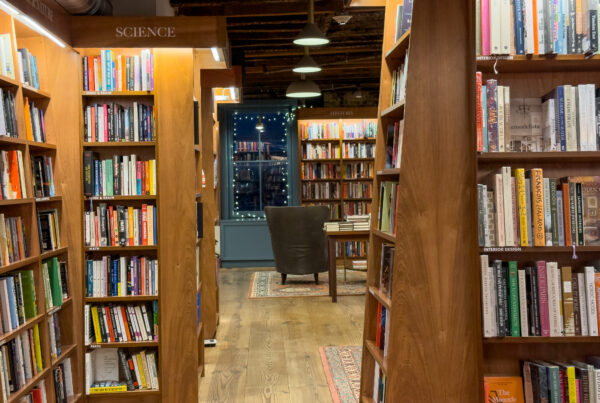
All photographs are by Pamela Thomas-Graham for Dandelion Chandelier.
the best books to read in november
November is the month of the full table and the empty chair. The train home, the airport gate before dawn, the first serious coat, the family text chain, the candle after the dishes, the public ceremony, the private inventory. The days shorten. The light lowers. The year stops flirting with change and starts asking for evidence.
September is the reset. October is the haunting. November is the reckoning.
That does not mean November reading should be grim. It should have wit, appetite, family comedy, old houses, bad timing, grandmothers, daughters, estranged fathers, inconvenient children, inherited money, public myths, private losses, sacred duties, ruined plans, and at least one sentence that makes gratitude feel less like a slogan and more like a discipline.
The Thanksgiving table is part of it, of course. But November is larger than Thanksgiving. The Thanksgiving Reading Room owns gathering, gratitude, food, appetite and the table. Veterans Day owns remembrance, war, soldiers, service and the aftermath of conflict. November owns the larger late-autumn reckoning: family, faith, homecoming, inheritance, care, estrangement and the first shadow of winter.
This is not cozy reading, exactly. It is candlelit accountability.
how to read november
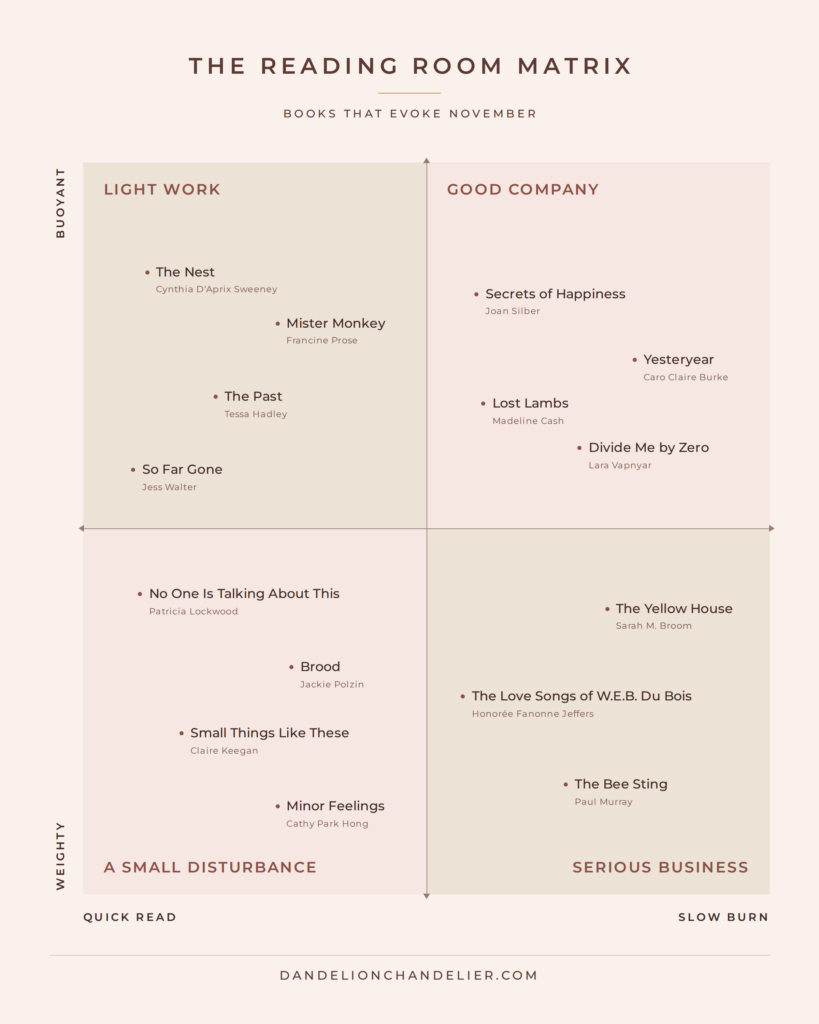
If you loved one, read the next
The Reading Room Matrix is also a bridge: start with a book you already love, and let it carry you to one you haven’t met yet.
Loved Small Things Like These? Read Brood. Keegan’s moral hush, carried into Jackie Polzin’s quiet year of tending four chickens after a loss — the same conscience, the same low winter light, the same devotion that refuses to announce itself.
Loved The Bee Sting? Read Lost Lambs. If Murray’s family-coming-apart was your weather, Madeline Cash brings the same serrated comedy and tenderness to a household where dysfunction has become the native language.
Loved No One Is Talking About This? Read Divide Me by Zero. Lockwood’s brainy, fragmented grief finds its match in Lara Vapnyar’s novel of mothers, mathematics and emigration — formally playful, quietly devastating, sharp about the impossibility of making a life add up.
Loved Ghana Must Go? Read The Yellow House. Selasi’s scattered family, summoned home, opens onto Sarah M. Broom’s memoir of one New Orleans house holding a mother, twelve children and a city — homecoming as both shelter and question.
the long journey home
November begins with return. Not always literal return, although there are planes, trains, guest rooms, old bedrooms, childhood houses and the unmistakable smell of someone else’s kitchen. The deeper return is to the story that made us, and the parts of it we have spent years trying to revise.
1. ghana must go by taiye selasi.
Taiye Selasi’s Ghana Must Go is a homecoming novel with international voltage. Kweku Sai, a brilliant Ghanaian surgeon who built and lost a life in America, dies suddenly in Ghana. His estranged family — wife, sons, daughters, each carrying the private weather of abandonment, excellence, shame and longing — is drawn back toward one another.
This is a novel about diaspora, yes, but also about the myth of the exceptional family. The Sais are beautiful, gifted, wounded, scattered. They have the kind of intelligence that can become armor and the kind of pride that makes apology feel impossible until grief rearranges the room.
2. the past by tessa hadley.
Tessa Hadley’s The Past is the country-house novel as family x-ray. Four adult siblings return with partners and children to their grandparents’ old house in the English countryside, intending to decide whether to keep or sell it. Naturally, the house has opinions.
Hadley is exquisite on ordinary tension: the slight correction, the glance across a kitchen, the old sibling role that reappears the minute one walks through the door. The novel’s pleasures are quiet, but not mild. Desire stirs. Children wander. Memories surface. Rooms become moral territory.
3. the yellow house by sarah m. broom.
Sarah M. Broom’s The Yellow House is a memoir of family, place, race, architecture and erasure. The house of the title stood in New Orleans East, bought by Broom’s mother, Ivory Mae, in 1961. It was home, inheritance, aspiration, burden, witness and eventually a structure destroyed in the aftermath of Hurricane Katrina.
This is not a simple house memoir. It is a map of a family and a city, of who gets remembered, who gets served, who gets displaced and what it means to belong to a place that official narratives misread or ignore. Broom writes with documentary force and lyrical control, making one house hold the story of twelve children, one mother, one neighborhood and one American failure of attention.
4. the love songs of w.e.b. du bois by honorée fanonne jeffers.
Honorée Fanonne Jeffers’ The Love Songs of W.E.B. Du Bois is a sweeping American family novel about ancestry, race, memory, land, violence, love and inheritance. At its center is Ailey Pearl Garfield, a young Black woman coming into herself while carrying generations of family history that stretch across the American South and far beyond the boundaries of any one life.
This is November on a grand scale: the family story as national ledger, the private life braided into public history, the truth that inheritance is never only what is given. Sometimes it is what survives. Sometimes it is what was stolen. Sometimes it is the name, song, recipe, silence or wound passed down with no explanation and too much force.
families with weather in the walls
Some families are houses. Some houses are arguments. Some inheritances arrive as money, some as silence, some as habits of harm dressed up as tradition. These books belong to November because they understand that family weather can be beautiful, brutal and very hard to leave.
5. the nest by cynthia d’aprix sweeney.
Cynthia D’Aprix Sweeney’s The Nest is the inheritance novel for anyone who has ever watched adult siblings turn a future windfall into an emotional support animal. The Plumb siblings have been counting on “the Nest,” a family trust expected to solve various financial, marital, professional and personal problems. Then one brother’s spectacularly bad behavior threatens the whole arrangement.
It is funny because money is funny in families, until suddenly it is not. Sweeney understands inheritance as fantasy: the imagined rescue, the imagined proof of love, the imagined correction to one’s own mismanagement. She also understands New York as a city where shame can wear a very good coat.
6. secrets of happiness by joan silber.
Joan Silber’s Secrets of Happiness is a novel of linked lives, hidden families, illness, infidelity, money, care and the strange ways one person’s private arrangement becomes another person’s inheritance. Silber’s structure moves from character to character, following consequences across households, continents and moral weather systems.
It is a perfect November book because the month is full of belated connections. Someone learns what someone else has known for years. A secret becomes a duty. A family enlarges in the most inconvenient possible way. Love becomes less a feeling than a set of obligations one did not audition for.
7. the bee sting by paul murray.
Paul Murray’s The Bee Sting is a family novel with weather in every wall: economic anxiety, marital fracture, adolescent pain, climate dread, denial, accident, memory and the terrible comedy of people insisting everything is fine while the structure is already groaning.
The Barnes family is coming apart in an Ireland shaped by the aftermath of financial collapse, and Murray lets everyone speak: parents, children, the past, the future, the part of the family story everyone thinks someone else is managing. The result is expansive, funny, tragic and emotionally ruthless in the best way.
8. lost lambs by madeline cash.
Madeline Cash’s Lost Lambs brings a newer, sharper, slightly unhinged family energy to November. The Flynn family is in trouble: marriage fraying, daughters in crisis, faith and power pressing on the house, satire and tenderness pinging off one another until dysfunction begins to feel like the family’s native language.
What makes the novel useful here is its insistence that family life is not tidy even when everyone is trying very hard to arrange themselves into a respectable shape. Cash writes with speed, bite and a comic willingness to let chaos reveal what politeness cannot.
9. yesteryear by caro claire burke.
Caro Claire Burke’s Yesteryear is a November novel disguised as a high-concept trapdoor. Natalie Heller Mills is a tradwife influencer whose public life depends on selling a fantasy of rustic domestic virtue: marriage, motherhood, faith, obedience, home, children, order, beauty and the glow of a past she has carefully edited for modern consumption.
Then she wakes into the brutal reality of the historical life she has been performing.
What makes the novel so useful for November is not only the speculative premise. It is the family reckoning. Yesteryear understands that “home” can be the most dangerous word in the room when it has been turned into a brand, a cage, a doctrine or a story everyone else is required to believe. The family is not background here. It is the stage, the audience, the alibi and the jail term.
10. dèy by edwidge danticat.
The word is Haitian Kreyòl for mourning. Moving between Haiti, Brooklyn and Miami, Magnolia — a Haitian American real estate agent — survives a sudden act of violence, tells no one, and finds it loosening everything she’d kept sealed: a daughter she adores, a mother whose unraveling she fears she is inheriting, a father’s second family, the losses Haiti hands her people almost daily. It belongs in November because the month is about what we owe the people we come from, and whether love can shield anyone from harm. Danticat asks the season’s hardest question — is home where you are born, or where you die? — and refuses to make the answer comfortable.
mothers, daughters and the private arithmetic of care
By mid-November, the family table begins to appear in the imagination. Not only Thanksgiving, although yes, the turkey, the seating plan, the person who should not be seated near the other person, the cranberry sauce with unearned confidence. The table is also symbolic: mothers, daughters, grandmothers, secrets, pregnancies, illnesses, children, internet worlds, private losses and the intimate labor of keeping one another alive.
11. fight night by miriam toews.
Miriam Toews’ Fight Night is a novel of three generations of women, narrated by nine-year-old Swiv, whose pregnant mother is struggling and whose grandmother, Elvira, is a force of comic, defiant, gloriously ungovernable life.
The women in Fight Night are battered by grief, illness, history, depression and absurdity, but the novel refuses solemnity as proof of seriousness. It is funny in the way the strongest families are funny when they have had enough of tragedy’s manners. Elvira is one of those grandmothers literature gives us as a public service: outrageous, tender, impossible, necessary. She teaches Swiv not only how to endure, but how to swing.
12. the mothers by brit bennett.
Brit Bennett’s The Mothers begins with young love, grief, pregnancy, secrecy and the chorus of older church women who watch, judge, narrate and remember. Nadia Turner, mourning her mother’s suicide, becomes involved with Luke, the pastor’s son. Their choices ripple outward through friendship, faith, ambition and the women they become.
The title does a great deal of work. The mothers are literal, absent, imagined, communal, moral and mythic. Bennett writes beautifully about the lives young women might have lived, the selves they abandon and the particular ache of being watched by people who think they know the whole story.
13. the margot affair by sanaë lemoine.
Sanaë Lemoine’s The Margot Affair is a Paris novel of secrecy, public life, family legitimacy and the hunger to be acknowledged. Margot is the hidden daughter of a famous actress and an even more famous married politician. Her life has been shaped by discretion, which is one of the more elegant names for erasure.
The novel has all the pleasures one wants from a Paris book: atmosphere, apartments, restaurants, emotional geometry. But its real subject is recognition. What does a daughter owe a mother whose life depends on secrecy? What does a public man owe the private family he has kept offstage? What happens when a young woman decides that being protected and being hidden may not be the same thing?
14. divide me by zero by lara vapnyar.
Lara Vapnyar’s Divide Me by Zero is a novel of mothers, mathematics, emigration, art, marriage, memory and the absurdity of trying to impose order on a life determined to misbehave. Katya’s mother, a mathematician in the Soviet Union, is dying; Katya’s marriage is ending; her memories of Russia, America, family and desire keep rearranging themselves.
Division by zero is impossible, and yet family life often asks us to perform similar operations: calculate grief, solve for loyalty, balance desire against duty, turn the past into a usable equation.
Vapnyar is funny, brainy, melancholy and sharp about immigrant life, female ambition and the emotional uses of intellectual systems. The result is a book for anyone who has ever tried to make a spreadsheet of the heart.
15. no one is talking about this by patricia lockwood.
Patricia Lockwood’s No One Is Talking About This begins in the portal: that frantic, absurd, brilliant, deranging online consciousness where language moves faster than feeling and everything becomes content before it can become thought. Then the book changes. A family emergency arrives, and the narrator is pulled out of the portal and into a world of bodies, babies, hospitals, love, grief and presence.
It is one of the great novels of attention in the internet age. Lockwood understands the comedy of digital life, but she also understands its poverty when real suffering enters the room. The tonal shift is the point. The book does not reject the portal so much as reveal what it cannot hold.
16. if you love it, let it kill you by hannah pittard.
Hannah Pittard’s If You Love It, Let It Kill You belongs to November because it asks one of the month’s more dangerous questions: what happens when devotion stops looking noble and starts looking like self-erasure?
This is a novel of art, desire, marriage, domesticity, creative life and female freedom. It is sharp about the stories women are encouraged to tell about sacrifice, and sharper still about the point at which a life organized around love, work, loyalty or family begins to ask for too much.
faith, attention and the first winter light
By late November, the air changes again. The holiday season has begun assembling itself in windows. The days feel shorter than they have any right to be. The mind turns inward, but not gently. These final books bring us faith, conscience, race, performance, grief, care and the question of what can still be repaired.
17. transcendent kingdom by yaa gyasi.
Yaa Gyasi’s Transcendent Kingdom is one of the clearest November novels on the shelf. Gifty, a Ghanaian American neuroscience PhD candidate at Stanford, studies reward-seeking behavior in mice while trying to understand her brother’s addiction, her mother’s depression, her childhood in an evangelical church and the faith she has both lost and not entirely escaped.
This is a novel of grief and discipline, science and prayer, ambition and loneliness, family love and the terrible inadequacy of explanation. Gifty wants knowledge to do what knowledge can do. She also knows, painfully, what it cannot.
18. small things like these by claire keegan.
Claire Keegan’s Small Things Like These is slim, winter-lit and morally radiant. Set in an Irish town in 1985, it follows Bill Furlong, a coal merchant and father, as he encounters a truth connected to the local convent and must decide whether to look away or act.
The book is almost shockingly quiet. That is part of its power. Keegan understands that moral courage is not always dramatic in the moment. Sometimes it is a small choice made against the grain of complicity, reputation, convenience and fear.
19. brood by jackie polzin.
Jackie Polzin’s Brood is a quiet wonder: a novel about a woman caring for four chickens over the course of a year after an unnamed loss. That description sounds almost comically modest. The book is anything but.
This is a novel of attention, marriage, grief, care, weather, bodies, fragility and the moral seriousness of tending to small lives. The chickens are chickens. They are also companions, burdens, mysteries, symbols, irritants and a way for the narrator to stay attached to the world.
20. minor feelings by cathy park hong.
Cathy Park Hong’s Minor Feelings: An Asian American Reckoning gives November one of its clearest words: reckoning. This essay collection moves through race, language, art, shame, anger, friendship, invisibility, immigrant inheritance and the psychic dissonance of being told a story about America that does not match one’s experience of living in it.
Hong’s intelligence is sharp, restless and formally alive. She does not smooth the edges of feeling into uplift. She is interested in what happens when emotions are dismissed as minor because the people feeling them have been made minor in the cultural imagination.
21. mister monkey by francine prose.
Francine Prose’s Mister Monkey is a theater novel, a New York novel, a backstage comedy and a surprisingly tender study of disappointment and connection. A troubled off-off-off-Broadway production of a children’s musical becomes the center around which actors, audience members, crew and bystanders orbit, each carrying a private history into the absurd little world of the show.
It is an excellent late-November book because the city at this time of year is full of performances, official and otherwise. Holiday windows, school shows, family rituals, office cheer, charitable galas, rehearsed gratitude. Everyone is playing something. Everyone is also hoping to be seen past the costume. Prose is funny, humane and alert to the dignity of minor roles.
22. peck & peck by bonnie garmus.
Garmus follows Lessons in Chemistry with something funnier and stranger than its premise promises. Batter Gray, barely out of his twenties, talks his way into a prestigious, secretive, gloriously dysfunctional poetry journal because he believes — earnestly, against all evidence — that poetry might help us survive. Garmus writes ambition against safety, art against money, and the particular grief of a twin who died at birth, all with her signature warmth and bite. It earns its November place in the key of Mister Monkey: a New York comedy about people performing competence while privately hoping to be seen past the costume.
23. so far gone by jess walter.
Jess Walter’s So Far Gone gives November its late-American road: family fracture, political estrangement, a reclusive former journalist, a missing daughter, endangered grandchildren and the painful question of whether repair is still possible after years of withdrawal.
It is a road novel through a fractured country and a family novel about the consequences of leaving the world too completely. Walter has always been good at comedy with bruises underneath it, and here the humor carries serious freight: conspiracy, alienation, grandparenthood, civic exhaustion, and the difficult work of returning to people one has failed.
final thoughts: the reckoning
November is the season’s last serious room before the holidays begin rearranging the furniture.
It is tempting to make it all warmth: the table, the pie, the coat, the train home, the brown leaves, the city windows glowing early, the first invitations, the first cards, the small luxury of a good book while someone else checks the oven.
And yes, November has warmth. But it also has teeth.
The best November books understand that gratitude is not denial. Home is not always comfort. Family is not always refuge. Faith is not certainty. Care is not sentimental because it is difficult. Inheritance is not only what is handed down. Memory is not optional. The old story may arrive at dinner, but the new one can still be written afterward.
That is why this month’s reading should feel rich, intimate, funny, painful, nourishing and clarifying. It should leave room for appetite and argument. It should know the smell of roasting butter and the chill of the station platform. It should understand that a family can be both shelter and weather.
September asks us to return with better judgment. October asks what has been waiting in the dark. November asks what we will do now that we know. The answer, as always, begins on the shelf.
where to go next
If you want the full autumn arc, begin with The Best Books to Read in September, where the fall arc opens with reset, ambition, campus life, work-adjacent lives, cultural re-entry and the first clean edit of the season.
Then move through The Best Books to Read in October, where autumn lowers the light and becomes haunting, not horror. For the full seasonal arc, read Edit Season: The Reading List for Fall, our distilled autumn shelf drawn from September, October and November. For the table itself — gathering, gratitude, hospitality, appetite, food history and the ritual of being fed — continue to our Thanksgiving Reading Room, A Literary Feast for Thanksgiving. For Veterans Day and Armistice Day — war, soldiers, service, homecoming from conflict, moral injury and the aftermath of combat — our Veterans Day Reading Room carries that work with the gravity it deserves.
faqs:
what are the best books to read in november?
The best books to read in November include Ghana Must Go by Taiye Selasi, The Past by Tessa Hadley, The Yellow House by Sarah M. Broom, The Love Songs of W.E.B. Du Bois by Honorée Fanonne Jeffers, The Mothers by Brit Bennett, Transcendent Kingdom by Yaa Gyasi, Small Things Like These by Claire Keegan, The Bee Sting by Paul Murray, Yesteryear by Caro Claire Burke and So Far Gone by Jess Walter.
what makes a good november reading list?
A good November reading list should include books about homecoming, family, inheritance, faith, grief, care, estrangement, houses, mothers and daughters, moral courage and late-autumn reckoning. November books should feel intimate and atmospheric, but not merely cozy. The best November reads understand that the full table and the empty chair are part of the same season.
what books should i read about family and homecoming?
Good books about family and homecoming include Ghana Must Go by Taiye Selasi, The Past by Tessa Hadley, The Yellow House by Sarah M. Broom, The Love Songs of W.E.B. Du Bois by Honorée Fanonne Jeffers, The Nest by Cynthia D’Aprix Sweeney, Secrets of Happiness by Joan Silber and The Bee Sting by Paul Murray.
what are good books about mothers and daughters for november?
Good November books about mothers and daughters include Fight Night by Miriam Toews, The Mothers by Brit Bennett, The Margot Affair by Sanaë Lemoine, Divide Me by Zero by Lara Vapnyar, No One Is Talking About This by Patricia Lockwood and Yesteryear by Caro Claire Burke. These books explore secrecy, care, grief, pregnancy, faith, performance and the complicated inheritance of womanhood.
what nonfiction books are good to read in november?
Good nonfiction books to read in November include The Yellow House by Sarah M. Broom, Minor Feelings by Cathy Park Hong and, for the wider Thanksgiving lane, The Cooking Gene by Michael W. Twitty and Praise Song for the Kitchen Ghosts by Crystal Wilkinson. November nonfiction should carry memory, place, race, home, inheritance and moral reckoning.
how is november different from thanksgiving and veterans day for reading?
November is the larger late-autumn reckoning: family, homecoming, inheritance, faith, grief, care and winter’s approach. Thanksgiving owns the table: gathering, gratitude, hospitality, food history, appetite and being fed. Veterans Day owns remembrance: war, soldiers, service, moral injury and the aftermath of conflict.
how is november different from september and october for reading?
September is the reset: campus, work-adjacent lives, ambition, cultural re-entry and the first edit of fall. October is the haunting: ghosts, witches, memory, houses, archives, cities and things that refuse to stay buried. November is the reckoning: family, homecoming, inheritance, faith, grief, care and the moral clarity that arrives before winter.