

Power casual dressing for women is what happens when formal dress codes loosen but judgment does not. It is a way of dressing that combines ease with authority, using proportion, fabric, fit and one decisive element — a jacket, trouser, skirt, shirt, dress, coat or shoe — to make the wearer look composed without looking formally dressed. Unlike business casual, which is essentially a uniform, power casual is a judgment system. It asks a more useful question than “Is this appropriate?”: How do I want to be read in this particular room?
That distinction matters because modern professional life is full of rooms that insist they are casual while continuing to read appearance with remarkable fluency. A board meeting, investor breakfast, client lunch, museum dinner and creative off-site may all dispense with the old uniform, but none is neutral. After enough years in corporate life, you learn that the point is not to eliminate complexity. It is to get good at reading it.
Call to Order is Dandelion Chandelier’s ongoing series on strategic dressing for people who mean business — a study in authority, polish, and the quiet power of getting it exactly right.
At a glance: power casual • authority without stiffness • business casual vs. power casual • five laws of casual authority • reading the room • one decisive piece • structure without strain • dressing with resolve
casual is still a code
Since moving to TriBeCa from the West Village, my morning coffee run has become an accidental seminar in power casual. I pass women whose jobs I could not begin to guess from their clothes, which is precisely what interests me. One may be running a fund, another heading to a board meeting, another going to a studio or a client lunch. The biography is illegible; the authority is not. Nothing looks studied, nothing looks apologetic, and nothing seems to be asking whether it is sufficiently important.
Men have had the advantage of clearer uniforms for years. Tech gave them the good T-shirt, jeans and expensive sneaker; finance perfected the quarter-zip into something close to institutional identification. The codes may not be thrilling, but at least they have the courtesy to be obvious. Women were given freedom instead, which sounded excellent until somebody had to decide what “smart casual” meant at eight-thirty on a Tuesday when the meeting matters but the jacket feels like too much.
casual dressing is harder than it looks
This is why casual dressing can be more demanding than formal dressing. Formality supplies instructions. Casualization removes the instructions while leaving the judgment intact. A dress code that says “casual” is often simply outsourcing the decision to you, and the interesting part is not whether that is fair. It is whether you can make the decision cleanly enough to stop thinking about it.
That is the point of power casual. It is not about looking relaxed for the sake of looking relaxed, and it certainly is not about dressing as though hierarchy vanished because the necktie did. It is about understanding the room, your role in it and the amount of structure the situation actually requires. Power casual isn’t about dressing down. It’s about dressing with resolve.
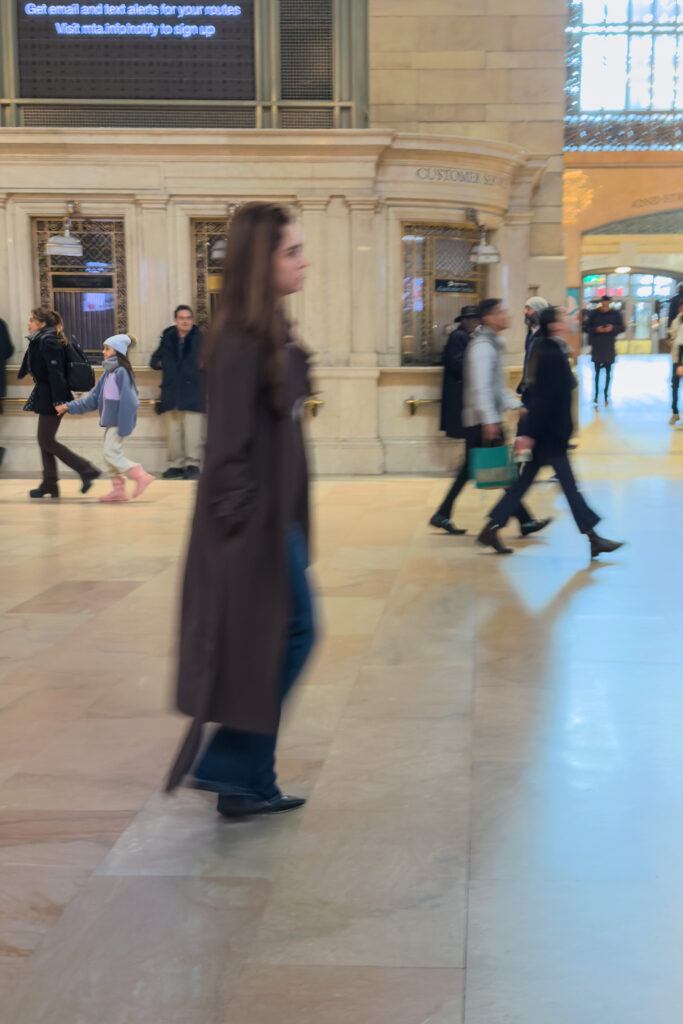
Authority, in motion.
business casual is a uniform; power casual is a judgment system
Business casual was built to answer a dress-code question: what can I wear instead of a suit and still look professional? Power casual answers a harder one: how do I preserve authority when the uniform no longer tells the room what to think? That is why the two should not be confused. One is a category of clothes. The other is a way of deciding.
The difference becomes obvious the minute context changes. Dark trousers and a shirt may be perfectly competent in almost any office, but competence is not always the assignment. Sometimes the room calls for more presence; sometimes less. At times, the right move is a beautifully cut blazer over denim. But sometimes it is a skirt with enough architectural clarity to carry the look by itself. Sometimes it is a coat, a pair of glasses or a shoe that introduces the necessary line while everything else stays quiet.
If Serious People Don’t Suffer for Style is the argument that clothes should not consume the attention you need to lead, this is its companion argument: when formal rules disappear, judgment replaces the uniform. The goal is not to look powerful. It is to remove the gap between the person you are and the person the room sees before you say a word.
five laws of casual authority
1. read the room before the dress code.
Dress codes are broad labels; rooms are specific organisms. A board meeting is not a board dinner. An investor breakfast is not a creative retreat. A museum preview is not a neighborhood dinner simply because both invitations say “casual.” The room has a hierarchy, a pace, a degree of visibility and a social temperature, and those signals are usually more useful than whatever was typed on the invitation.
After decades around corporate and cultural institutions, I have found that the most reliable question is not “What is everyone else wearing?” It is “What is my role here?” If I am presenting, presiding, negotiating or representing an institution, I want enough structure that there is no visual ambiguity about why I am in the room. If I am attending as a guest, listening or looking, I can afford more ease. This is not costume. It is fluency.
The cultural rooms are especially revealing because they punish overstatement almost as efficiently as they punish timidity. Our guide to what to wear to Art Basel and every other serious art fair makes the same point from another angle: the clothes should register, but they should not audition.
2. one decisive piece is usually enough.
The easiest way to look overworked is to make every element of an outfit prove that you understood the assignment. Power casual improves dramatically when one piece carries the authority and the rest support it. That might be the long line of a blazer, the sweep of a trouser, the clean geometry of a skirt, the collar and cuff of a shirt, a column dress or a coat whose proportion settles everything underneath.
This is where certain houses are useful as design vocabularies rather than shopping lists. The Row understands the long line and the confidence of restraint. Jil Sander has long understood structure stripped of aggression. Prada is exceptionally good at seriousness with intellectual mischief — the sober skirt or coat whose proportion is impeccable enough to permit an oddity without losing authority. Khaite brings a particularly New York tension between polish and informality, while Loro Piana demonstrates what material ease looks like when nobody needs the logo to explain the price.
The lesson is not to dress head to toe in any one of them. It is to notice the idea each does well and use it where your own wardrobe needs clarity. One decisive piece can set the sentence; the rest of the outfit does not need to keep shouting the same point.
3. ease still needs structure.
There is a persistent misconception that relaxed dressing means removing structure. In practice, the opposite is usually true. The more casual the clothes become, the more useful a clear line is somewhere in the outfit — a shoulder that sits correctly, a trouser with a real hem, a skirt that holds its shape, a shirt with enough body to frame the face, a shoe that grounds the silhouette rather than dissolving beneath it.
Structure is not the same thing as stiffness. This is one of the central ideas in Serious People Don’t Suffer for Style: discomfort is not evidence of seriousness, and a garment that requires constant negotiation is siphoning attention from somewhere more important. The same distinction matters here. A soft jacket can provide structure. A fluid trouser can carry authority. A flat shoe can make a stronger line than a heel if it gives you better posture, pace and stamina.
The best power-casual clothes allow the body to behave normally while keeping the silhouette legible. That is what makes them useful across a day that may include walking, sitting, presenting, traveling and dinner without the wardrobe needing a strategic review at five o’clock.
4. remove visual negotiation.
There are outfits that make the wearer look interesting, and there are outfits that make everyone wonder what the wearer was trying to do. The difference is usually coherence. Power casual works when the eye understands the hierarchy of the outfit immediately: this is the main line, this is the supporting color, this is the shoe, done.
That does not mean neutrality. Color can do enormous work when it is given a job. Dark red, for example, can supply authority without the finality of black, particularly in a blazer, coat, skirt or shoe. The distinctions matter more than people think; our Color Desk guide Maroon Is Not Burgundy: How to Wear Dark Red explains why oxblood, burgundy, maroon and black cherry send different signals even when a retailer would happily file them all under “wine.”
Accessories should operate on the same principle. The right glasses can sharpen the entire reading of a face, which is why The Glasses That Read the Room belongs in this conversation. A bag, brooch, watch or pair of earrings can provide the point of view, but none should require a supporting cast. Visual negotiation is tiring for the viewer and, worse, for the wearer.
5. dress with resolve, not reassurance.
There is a particular kind of outfit that comes from wanting to be certain nobody could possibly think you were underdressed. It usually contains one formal element too many. The jacket is sharper than necessary, the shoe more ceremonial, the jewelry more emphatic, and the whole thing begins to look like it is seeking reassurance from the room.
Resolve is different. It comes from deciding what the situation requires and stopping when you have met it. In senior rooms, this matters because over-signaling authority can be as distracting as under-signaling it. The person with the most power is often the one least interested in advertising the fact, although this is not an argument for dressing blandly. It is an argument for knowing which signals you actually need.
This is also where personal style finally becomes useful rather than decorative. Once you know your own authority silhouette — perhaps long trousers and a soft jacket, perhaps skirts and architectural shirts, perhaps dresses and strong flats — you can repeat it without looking repetitive. Repetition creates recognition; recognition reduces friction. The wardrobe begins behaving like a language you already speak.
what the theory looks like in clothes
A power-casual wardrobe does not require a new taxonomy of garments. The familiar categories work perfectly well; they simply have to carry more of the decision. A blazer should alter posture without looking armored. Trousers need enough line to survive a serious room but enough ease to survive the day. A skirt should feel deliberate rather than dutiful, which is why Prada remains such a useful reference: the house has spent decades demonstrating that a skirt can be intelligent, authoritative and slightly subversive at the same time.
The shirt may be the most underrated piece in the whole system. A crisp or generously proportioned shirt frames the face, introduces architecture and can make denim or a relaxed trouser look entirely intentional. Phoebe Philo has long understood the intelligence of this kind of proportion: nothing overexplained, nothing cinched for reassurance, nothing pretending that a woman needs ornament before she can occupy space.
Dresses work when they close the question rather than opening six new ones. Coats matter because they are often the first garment the room sees and the last one it remembers. Shoes matter because authority has a physical component: posture, balance, stamina, the ability to cross a lobby or stand through a reception without beginning to bargain privately with your own feet. This is not glamorous advice, but it becomes increasingly persuasive after the first twenty years of work.
The common denominator is not price or formality. It is decisiveness. The clothes know what they are doing, which leaves you free to do the same.
four questions before getting dressed
When the dress code is vague and the room matters, I find four questions more useful than a trend report:
- Who has authority in this room, and how formally is that authority usually expressed? The answer tells you whether the culture values traditional polish, creative fluency, discretion, individuality or some combination of the four.
- What is my role here? Presenting, hosting, negotiating, observing and attending are different jobs. Your clothes can acknowledge that without turning the role into costume.
- What does “casual” mean in this particular institution or social world? Casual at a technology company, a bank, a design studio, a museum board and a private dinner are not five versions of the same thing. They are five dialects.
- What do I need the clothes to let me forget? Weather, walking, a long presentation, a flight, an evening event, an unpredictable thermostat — solve those problems before the day begins and you preserve attention for the reason you got dressed in the first place.
This is also why the question “what should I wear?” is rarely just a shopping problem. AI Can Pick an Outfit. But Can It Read the Room? explores the larger issue: context, timing, hierarchy and social intelligence are doing as much work as the clothes themselves. The more ambiguous the dress code, the less useful a generic answer becomes.
authority without theatrics
There is a reason the old power uniform has lost some of its grip. The suit was efficient because everyone understood the code, but it was also limiting because it allowed clothes to stand in for authority. Once the code loosened, women gained more room to dress like themselves, and with that freedom came a slightly more sophisticated assignment: to communicate judgment without relying on costume.
I prefer the new problem. It is more complicated, certainly, but complexity is not the enemy. Most of corporate life consists of reading imperfect signals, making decisions with incomplete information and understanding that context can change the meaning of an otherwise sensible choice. Dressing is hardly the most difficult version of that task; it just happens to be the one we encounter before coffee.
The most powerful person in the room rarely needs the most powerful-looking clothes. What she needs is coherence: between the institution and the moment, between her role and her clothes, between comfort and line, between what she wants to say and what she is perfectly content to leave unsaid. That is the territory Call to Order is built to explore, and it is why this essay sits naturally beside Serious People Don’t Suffer for Style. One argues that authority should not cost you attention; the other argues that when the uniform disappears, judgment matters more.
Power casual isn’t about dressing down. It’s about dressing with resolve.
faqs:
what is power casual dressing?
Power casual is relaxed professional dressing that preserves authority without relying on a formal business uniform. It uses proportion, material, fit, color and one or two decisive elements to create a clear, intentional look appropriate to the specific room rather than simply following a generic dress code.
how is power casual different from business casual?
Business casual is primarily a category of acceptable garments; power casual is a way of making decisions. Business casual asks whether an outfit is professional enough, while power casual asks how the wearer needs to be read in a particular setting and adjusts the level of structure, ease and individuality accordingly.
what are the essential pieces in a power-casual wardrobe?
The most useful pieces are a well-cut blazer, trousers with a clear line, an authoritative skirt, an architectural shirt, a simple dress, a strong coat and shoes that support both the silhouette and the demands of the day. The point is not to wear them all at once; one decisive piece is often enough.
can jeans work for power casual?
Yes, when the room genuinely permits denim and the rest of the outfit supplies enough structure. Clean denim with a strong jacket, crisp shirt, deliberate shoe or excellent coat can read authoritative; the question is less whether jeans are “allowed” than whether the entire look makes sense for your role and the institution.
how do you look authoritative without looking overdressed?
Aim for clarity rather than added formality. Choose one element that gives the outfit structure, keep the silhouette coherent and stop before every component begins making the same point. Authority usually reads more convincingly when it looks settled rather than defended.
can color work in a serious professional setting?
Absolutely. Color works when it understands the hierarchy of the room and has a clear job in the outfit. Deep reds, blues, greens and other complex shades can function almost like neutrals when the silhouette is disciplined and the rest of the palette gives them enough space.
what should I wear when the invitation says smart casual?
Treat “smart casual” as a clue, not a complete answer. Consider the institution, guest list, your role, the time of day and what happens before and after the event, then choose one element that establishes polish while allowing the rest of the outfit to remain relaxed.