

Who knew that there was such a thing as luxury salt? In recent years, simple salt has taken its place in the pantheon of luxury goods. Along with many other once-prosaic items, like butter, marshmallows and honey. So what’s the most expensive luxury salt in the world? What’s the best gourmet salt? Our correspondent Jillian Tangen has a primer on what you need to know about luxury salt.
how did salt become a luxury good?
We tend to think of salt as a an inexpensive, widely available commodity. After all, table salt is one of the least expensive items at the supermarket. It’s provided for free at fast food chains and delis the world over. It’s one of the most basic seasonings possible.
It would seem to be the opposite of a luxury good in every way.
However, in recent years, salt has been elevated to luxury status. It turns out that like everything else in life, you can spend as much money on salt as you want to. And we assure you, these are all facts; you don’t have to take that statement with a grain of salt.

take all of this with a grain of salt
Brief detour: do you know where that phrase comes from? Apparently, in 77 A.D., Pliny the Elder translated an ancient antidote for poisoning as follows: “Take two dried walnuts, two figs and twenty leaves of rue, pound them all together, with the addition of a grain of salt; this is proof against all poisons for that day.”
A grain of salt can protect you, and the phrase is a reminder to remain skeptical when you hear random statements that sound like fact but that may not actually be true. You know, like stuff you read on the Internet.
salt as a luxury item first took hold in Italy
During ancient Roman times, salt was considered so valuable that soldiers were sometimes paid with it. In fact, the word “salary” comes from the Latin word sal, for salt. So when a soldier was doing a lousy job, his paycheck might have been cut, which is how we ended up with the expression “not worth his salt.”
salt is essential for our health
For all of the health concerns around salt, including the risk of high blood pressure, stroke and heart failure, our bodies actually can’t live without. Salt facilitates the transport of nutrients and oxygen, allowing our nerves to transmit messages. It also helps to regulate our muscle contractions. In moderation, it’s an essential element of health and wellness.

salt is also key to elevated gourmet cuisine
We all know that using salt adds flavor to a dish – even people who never cook understand this. This is why chefs almost always consider salt as one of the most important ingredients in whatever dish they are cooking. From a simple pasta dish to an herb crusted rack of lamb to a fresh batch of chocolate chip cookies – the right amount and type of salt can elevate any dish to the next level. Yep, we’re looking right at you, salted caramel.
Why is that? Salt encourages the release of food molecules into the air, bringing out aroma. It can suppress bitterness and bring out sweetness, creating balance while enhancing other flavors.
Salt 101
While all salt is a form of sodium, the structure of the salt crystal plays an important role in its taste. So salt flakes – thin slivers of salt crystals – provide a greater surface area, and more flavor than salt grains.
Not all salts are created equal. Some are best for boiling water or creating a brine. Others are great for marinades, or for putting the finishing touch on a favorite dish. There are three major categories when it comes to salt, all of which serve a different purpose. Here’s what you need to know about the varieties of luxury salt. And what makes one type of salt this most expensive.
Table Salt.
Table salt is highly refined, usually iodized, and contains anti-caking agents to prevent clumping. Because it’s heavily processed, it’s got a sharp flavor that makes it easy to overuse. Table salt is best used for boiling pasta water or for a small dash at the table.

Table Salt
Kosher Salt.
This is the workhorse of restaurant kitchens. The name “kosher salt” comes from the fact that the crystals are good at drawing out moisture from meat. Hence, it is commonly used in the koshering process.
The larger size and grainier texture of kosher salt crystals are ideal for absorption, as well as for pinching and sprinkling. That’s why chefs almost always prefer it to table salt. The go-to kosher salt brand for many is Diamond Crystal ($4.50).
Sea Salt.
The most luxurious (and most expensive) category of salt is sea salt. Harvested from coastal waters, sea salt is the snow-white pyramid-shaped crystal that chefs use to add a final punch of flavor and crunch.
Within the category of sea salt, there are many types and colors from which to choose. And like all luxury goods, sea salts have product names that are elegant and evocative. Persian Blue Diamond Salt Stones. Pangasinan Star Sea Salt. Fumee Del Sel Chardonnay Oak Smoked Sea Salt. Who wouldn’t want to taste those?
The most prominent producer and chef favorite is Maldon Sea Salt ($5.50) which sources its flakes from the waters off Essex, England. But there are many, many more on the market. We could easily spend a whole day listing brands and types of sea salt. In an effort to keep it simple, here are the top four most popular varieties:
1. Fleur de Sel and Sel Gris.
Both of these sea salts come from France, but they’re harvested differently: sel gris (also known as Celtic salt) is large, coarse and grey, while fleur de sel (flower of salt), on the other hand, is round and delicate. Fleur De Sel Esprit Du Sel ($15) from the Isle of Rhé is one of the most popular and well respected brands to try.

The best gourmet luxury salt: Fleur de Sel Esprit du Sel. Courtesy Photo.
2. Pink Himalayan Salt.
Unlike the other sea salts that come from coastal waters, pink Himalayan salts are from mined from prehistoric ocean deposits in the Himalayas. In addition to adding a touch of color to the end of your dish this salt retains some of the minerality of the place it was harvested. Saltworks Himalayan Pink Salt ($8) is a great place to start.

The best gourmet luxury salt: Saltworks Himalayan Pink Salt. Courtesy Photo.
3. Smoked Sea Salt.
If you are looking for a sea salted finish with a dash of favor, smoked sea salt is a great option. For example, Saltverk Birch Smoked Salt ($13) is produced with 100% geothermal energy in the Westfjords of Iceland. It works great on meat and fish. Of course there are also many other flavored infused salts, beyond smoked. They include saffron salt, truffle salt and even wine-infused salt.

The best gourmet luxury salt: Saltverk Birch Smoked Salt. Courtesy Photo
4. Black Hawaiian Salt.
Also known as lava salt, black Hawaiian salt is sea salt blended with activated charcoal. Kiawe Smoked Sea Salt ($18) is derived from waters that are brought up to the surface from 2,200 feet deep and dried by the sun in a natural manner to create a light, flaky crystal. It works best of delicate dishes like roasted vegetables, poke and crudo.

The best gourmet luxury salt: Hawaiian Kiawe Smoked Sea Salt. Courtesy Photo.
what’s the best gourmet salt in the world?
the great specialty shop The Meadow, run by “selmelier” and store co-owner Mark Bitterman, is a great source of knowledge about gourmet salts.
According to the experts at The Meadow, there is no such thing as a best salt to buy. However, when pressed they do admit that their Black Truffle Salt ($16) is their best-selling offering.
The folks at The Meadow suggest that instead of focusing on the best, try investing in a variety of salts. Experiment, and see what you really like. To help get you started, the Meadow offers a Salt Starter Set ($24) of six gourmet salts in 1-ounce tins. If trying something new is not your thing, though, they can give you guidance on which types of finishing salts would work best with a fish versus meat versus a savory dessert. They can also provide expert guidance if you require a special kind of salt for pickling or preserving projects.
The Spice Lab also has a great sampler for $56.

What to know about luxury salt: buying a sampler is a great way to start experimenting to see what you really like.
what’s the most expensive luxury salt in the world?
In terms of what to know about luxury salt, don’t be surprised by the cost. Prices for luxury salt can be surprisingly high. Icelandic Lava Flake? $67.00 for one pound. Pangasinan Star is a relative steal at only $64.00 a pound. That’s like 35 cents a shake.
salt pearls
You might think that “salt pearls” would be the most expensive kind of salt, given their name. You can buy naturally forming spheres of salt from Lake Assal in Djibouti, Africa. The combination of the salt, minerals and the movement of the water create smooth “pearls” that range in size from tiny “grains” to hefty ‘balls”. You can dip them in chocolate, leave a few floating in a soup, or even drop one and let it sink to the bottom of a cocktail.

What to know about luxury salt: Salt pearls are formed in Lake Assal, Djibouti, Africa.
Jukyeom salt
The most expensive salt in the world, though, is from Korea. Known as jukyeom, or bamboo salt, the makers begin with coarse Korean gray sea salt. They places the crystals inside a cylinder of aged bamboo, seal it with clay, and roast it at temperatures nearing 1,500 degrees. They repeat this process nine more times. Then they roast the crystals again at an even hotter temperature that causes the salt to melt. The final step is pouring out this molten liquid and waiting for it to harden into crystals. It sounds like the process for making mezcal!
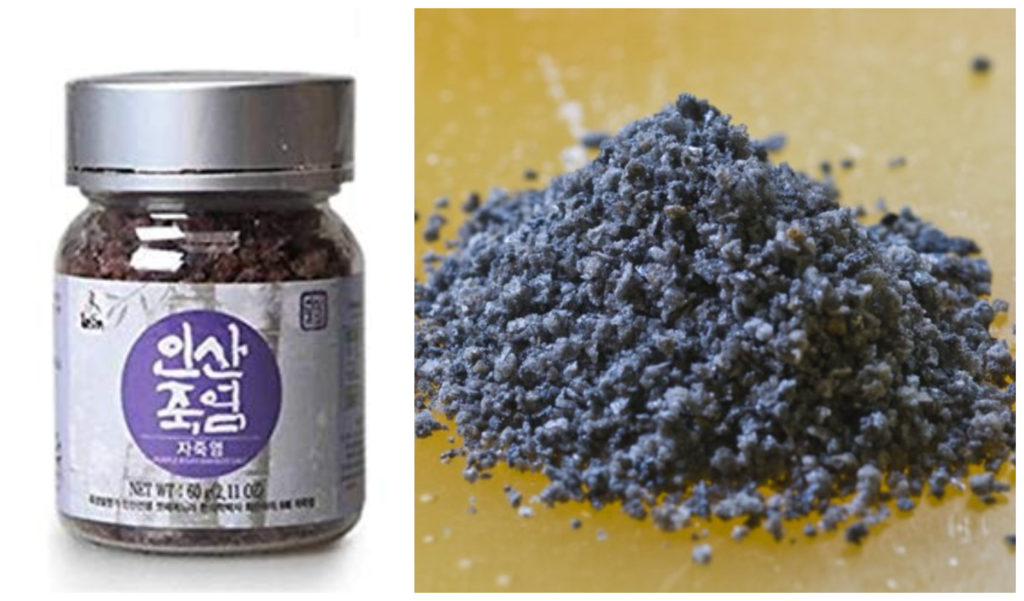
What’s the most expensive luxury salt? Korean Bamboo Amethyst Salt. Courtesy Photo.
The resulting salt is said to be powerful, with an aromatic, smoky, sulfuric and slightly sweet flavor. We have read that it needs to be eaten sparingly, because on its own it’s way too intense. If you’re ready to take the challenge, you could try this Amethyst Bamboo 9x ($98).
luxury salt 101
That’s the basic overview of the world of luxury salt. We don’t know about you, but we’re totally in on this idea. Reading about these different salts really makes us want to travel. And imagine what great stories we’ll be able to tell at dinner parties after cooking with one of these! Turns out that luxury salt is not such a flaky idea after all.
join our community
For access to insider ideas and information on the world of luxury, sign up for our Dandelion Chandelier newsletter here. And see luxury in a new light.
 Jillian Tangen is the Head of Research at Dandelion Chandelier. Formerly, she was a Senior Research Analyst at McKinsey & Co and Analyst at Shearman & Sterling. She is an avid fan of Nordic design, having owned an independent lifestyle store and sales agency focused on emerging Scandinavian design. Jillian lives in NYC and is married with three young children. She loves cross country skiing, the New York Rangers, reading, travel and discovering new brands.