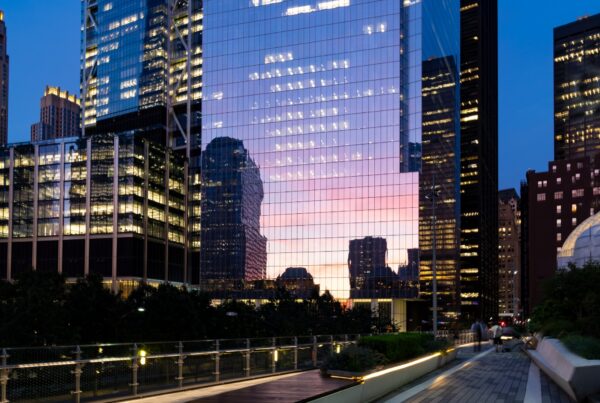


The New Museum Reopens
The Art Lens is Dandelion Chandelier’s ongoing series on art and visual culture, exploring how artists, exhibitions, and artworks shape perception, memory, and meaning beyond trend.
At a glance: March 2026 • Lower East Side, New York • New Museum reopening • OMA expansion • New Humans: Memories of the Future • architecture, atmosphere, and art-world style
All photographs in this post were taken by Pamela Thomas-Graham exclusively for Dandelion Chandelier.
The New Museum reopens to the public on Saturday, March 21, 2026, with a major OMA-designed expansion and an inaugural exhibition, New Humans: Memories of the Future, that asks what remains of the human in an age of technological acceleration.
The architecture feels open, lucid, and newly social. The exhibition, at least on this first encounter, feels dark, punishing, and almost theatrically bleak.
That tension is the story.
There are museum reopenings that feel like a return.
This one feels more like a molting.
On the Bowery, the New Museum has emerged with a major new building by OMA that expands the institution physically and transforms it emotionally. The original SANAA building still has its familiar stacked severity. The new structure does not imitate it so much as answer it. Together, they create a conversation between opacity and transparency, monument and circulation, coolness and invitation.
What struck me first was not the art, but the building.
That is not a small thing.
the building is the seduction

Inside, the museum now feels lighter, more porous, and much more social. There is natural light where you want it, openness where you need it, and a sense that movement itself has become part of the experience. The top-floor Sky Room, with its views looking uptown toward the spires of Midtown, offers exactly the kind of New York pleasure one never seems to tire of: architectural, cinematic, faintly unreal.
On a bright spring afternoon, the light does half the curating for you.
The staircases are especially good.
They do what the best museum staircases do, which is not merely move bodies upward. They stage proximity. They make social theater out of ascent and delay. They create little episodes of near encounter: someone pausing in shadow, someone arriving in a statement coat, someone glimpsed one level above and then lost again. They give the building rhythm. They also give it plot.
There is a particular spring palette here that softens the museum’s usual downtown severity. Moss green. Sky blue. Metal, glass, and shadow. The whole place has that elusive feeling of rebirth without sentimentality. Not sweetness. Clarity.

Rebirth, but make it downtown.
It is one of the rare cultural spaces in New York right now that genuinely feels new.
what the reopening gets exactly right

The expansion seems to understand something essential about contemporary museums: people do not only want rooms in which to look. They want spaces in which to arrive, gather, drift, cross paths, and feel themselves briefly part of a larger cultural current.
That matters.
Because the New Museum has always traded, at least in part, on the emotional voltage of the new. Not comfort. Not consensus. Not prettiness. Risk. Energy. Friction. The expanded building now gives that institutional identity a more generous physical form. It offers openness without diluting edge.

And at the preview, the crowd rose beautifully to the occasion.
Art World Chic remains one of New York’s more entertaining unofficial dress codes. There were people carrying the whole argument with a single bag or a single shoe. There were perfect jackets, smart tees, sharp little gestures of color. And then there were the full believers, dressed head to toe in that marvelous mode best described as not merely going to see art, but arriving as a work adjacent to it.
The mood was very Armory. Very Frieze. Very Lower East Side by way of a highly edited Europe.
and then the exhibition begins

The reopening exhibition, New Humans: Memories of the Future, is museum-wide and ambitious. Its premise is intellectually serious. Its scale is unmistakable. It asks large questions about technology, the body, memory, identity, mutation, and survival.
But my own response, at least on this visit, was immediate and blunt.
I found it horrifying.
Not in a productive haunted-house way. Not in the sharp, clarifying way that difficult art can sometimes wound you into a more truthful attention. More in the sense of being saturated with dread, violence, collapse, mutation, and spiritual exhaustion. The future presented here felt not charged, but brutalized. Not cautionary, but unrelenting. Not tragic in the classical sense, where suffering reveals something ennobling, but nihilistic in a flatter, more depleted register.

Then the mood darkened.
Perhaps on another day I would have met it differently.
That is the bargain we make with art, after all.
What we bring matters. The weather matters. The season matters. The soul has its own lighting design.
But on a sunny spring afternoon in a building full of light, air, ascent, and urban shimmer, this particular vision of the future felt like an aesthetic argument for despair. I left not chastened, exactly, but resistant.
Which is also a form of encounter.
after the frick, this felt like another civilization

What stayed with me most was the contrast.
Not long ago, I left the Frick’s Gainsborough exhibition feeling enlarged by beauty, reminded that portraiture, landscape, and light could still make life seem more vivid, more tender, more worth inhabiting. This was the opposite sensation. Here, the imaginative weather was scorched. The human figure seemed less like a vessel of possibility than a site of damage.
That contrast does not make one institution right and the other wrong.
It makes the city richer.
New York should contain both the life-affirming and the annihilating, the restorative and the merciless. A serious cultural life requires range. It requires the willingness to be delighted in one place and repelled in another, then to ask why. One of the quiet luxuries of living here is precisely that your inner life can be stretched by these encounters in a single week.
That, too, has value.
Even when your answer is hard no.
why this still matters
It matters because not every great cultural experience is pleasurable.
It matters because buildings can hold one emotional truth while exhibitions hold another.
It matters because a museum reopening is not only about the show on view, but about the kind of public life the institution is making possible for the city around it.
And it matters because the New Museum now has a building worthy of lingering in, returning to, dressing up for, and arguing about afterward over a drink downtown.
I suspect that is exactly as it should be.

The city walks right in.
The architecture sent me back into the street feeling newly awake to New York: to light on glass, to vertical shadow, to the elegant accident of strangers moving past one another in spring clothes at the right hour. The exhibition sent me out feeling less persuaded than provoked.
Sometimes that is enough.
Sometimes that is more than enough.
For anyone who cares about contemporary art, contemporary architecture, or the endlessly renewable theater of New York cultural life, this reopening is absolutely worth seeing. Go for the building. Go for the staircases. Go for the Sky Room and the spring light and the art-world anthropology of it all. Go even if you end up recoiling from the exhibition itself.
Especially then.
Because part of becoming a sharper viewer is learning to recognize not only what opens you, but what closes you down — and why.
As we have argued elsewhere in The Art Lens, the point of seeing more is not to agree with everything you see. It is to refine your own eye, your own language, your own threshold for what feels alive.

New look, same voltage.
faqs: the new museum reopens
when does the new museum reopen?
The New Museum reopens to the public on Saturday, March 21, 2026.
who designed the new museum expansion?
The expansion was designed by OMA as a counterpart to the museum’s original SANAA-designed building.
what is the opening exhibition at the reopened new museum?
The inaugural exhibition is New Humans: Memories of the Future, a museum-wide show exploring changing definitions of the human under conditions of technological and social upheaval.
what is the sky room at the new museum?
The Sky Room is the museum’s top-floor public space, with panoramic Manhattan views that make it one of the reopening’s loveliest architectural pleasures.
is the new museum reopening worth seeing even if the exhibition is difficult?
Yes. The reopening matters as architecture, as a civic and social space, and as a significant moment in New York’s cultural life even for visitors who find the inaugural exhibition emotionally punishing or aesthetically alienating.
what should you wear to a new museum opening or preview?
Think art-world polish rather than gala formality: a strong jacket, an intelligent shoe, one memorable accessory, or a look with enough personality to hold its own against downtown architecture and an opinionated crowd.
how does the new museum reopening compare with more traditional museum experiences in new york?
It offers almost the inverse of a classic old-master or Gilded Age museum pleasure. Where places like the Frick can feel restorative and harmonizing, the New Museum at its sharpest feels contemporary, argumentative, and emotionally unsettled. That tension is part of its point.