The best books to read for Thanksgiving are books about gathering, gratitude, food, family, hospitality, recipes, inheritance, kitchen objects and the emotional life of the table. This Thanksgiving reading list gathers 15 novels, memoirs, cookbooks and food histories for adults who want a literary feast: books that make the holiday feel deeper, more generous, more complicated and more luminous than the menu alone can hold.
The Reading Room is Dandelion Chandelier’s curated literary salon: monthly, seasonal and thematic reading lists chosen for beauty, intelligence, emotional resonance and the mood of the moment.
At a glance: Thanksgiving books • Thanksgiving reading list • books about gratitude • books about gathering • food writing books • cookbooks • family recipes • kitchen objects • books about the table
All photography is by Pamela Thomas-Graham for Dandelion Chandelier.
the right books for thanksgiving reading
Thanksgiving is not only a meal. It is a ritual of belonging.
That is why the right books for Thanksgiving are not simply books about turkey, pie or gratitude. They are books about what the table carries: family history, hospitality, labor, migration, recipes, ritual, care, appetite, body, land, memory, desire, forgiveness and the exquisite danger of sitting across from people who know exactly where the family ghosts are kept.
what to read during thanksgiving season
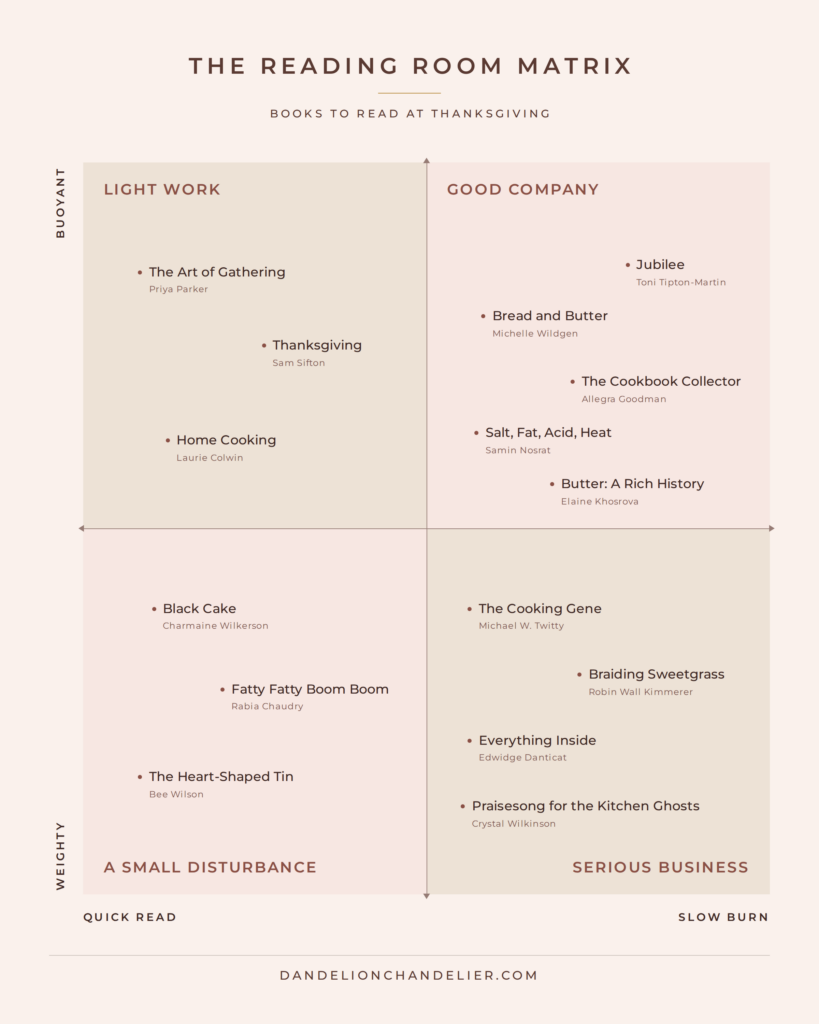
the spirit of gathering
The meal begins long before the first plate reaches the table. It begins with intention: why we gather, who is invited, what the room is being asked to hold, and whether the host has mistaken logistics for meaning.
1. the art of gathering by priya parker.
Priya Parker’s The Art of Gathering belongs at the front of the Thanksgiving shelf because it understands what the holiday is actually about. Not the centerpiece. Not the seating chart. Not the performance of ease after three days of shopping, chopping and cooking.
The heart of the matter is purpose. Why are we here?
Gatherings do not become meaningful by accident. They require a point of view; also exclusion and inclusion, rhythm and boundaries, welcome and clarity. The host’s job is not merely to feed people. It is to create the conditions in which the meal can become a moment.
2. thanksgiving: how to cook it well by sam sifton.
Sam Sifton’s Thanksgiving: How to Cook It Well is the practical Thanksgiving book that earns its place through tone as much as utility. It is bossy, reassuring, specific, funny and extremely clear on the central proposition that Thanksgiving dinner is not the day to improvise wildly unless one enjoys sending panic into the group chat.
This is the book for the cook who wants the bird handled, the sides respected, the timing understood and the holiday restored to something resembling pleasure. Sifton understands that Thanksgiving is both meal and performance, but he does not let performance become hysteria. Read it because competence, in November, is a love language.
family recipes and inheritance
Every family has a recipe box filled with stories: some written in ink, others whispered over simmering pots. The Thanksgiving table is never only what is served. It is what has been carried, adapted, protected, argued over and remembered.
3. the cooking gene by michael w. twitty.
Michael W. Twitty’s The Cooking Gene is one of the essential American food books because it refuses to separate cuisine from history, genealogy, labor, enslavement, migration, identity and survival. Twitty travels through the American South, tracing the foodways of his ancestors and the African American culinary traditions that shaped the nation’s table.
This is not food writing as lifestyle garnish. It is food writing as archive. The pot, the field, the spice, the seed, the smoke, the recipe, the hand, the memory — each becomes evidence. Twitty restores weight and lineage to the table, and reminds us that food is never innocent of history.
4. jubilee by toni tipton-martin.
Toni Tipton-Martin’s Jubilee: Recipes from Two Centuries of African American Cooking is a cookbook, a recovery project and a celebration. It brings forward the sophistication, range and authorship of African American cooks whose influence has shaped American cuisine far beyond the credit they were historically given.
This volume is abundant, elegant, deeply researched and joyous. It makes the Thanksgiving table larger, more truthful and more delicious.
5. home cooking by laurie colwin.
Laurie Colwin’s Home Cooking is one of the great books about the pleasure, comedy and consolation of feeding people. Her essays are intimate, funny, sensible and never precious. She understands that a kitchen is a place where things go wrong, and that this is often where the story improves.
The charm here is not perfection. It is presence. She writes as the friend one wants near the stove: opinionated but forgiving, witty but not brittle, full of affection for people and their appetites. Her version of home cooking is not performance. It is a form of companionship.
6. black cake by charmaine wilkerson.
Charmaine Wilkerson’s Black Cake is a family novel in which food carries the secret at the center of the story. Estranged siblings Benny and Byron reunite after their mother’s death and inherit, along with a traditional Caribbean black cake, a recording that unravels what they thought they knew about her life.
The cake is not a decorative symbol. It is memory made edible: migration, concealment, survival, love, loss and the ancestral intelligence of a recipe that outlives the person who made it.
appetite, ambition and the work of feeding people
The Thanksgiving table can make cooking look romantic, but food is also work: professional, emotional, familial and bodily. These books bring ambition, restaurants, appetite, body politics, collection and technique into the room.
7. bread and butter by michelle wildgen.
Michelle Wildgen’s Bread and Butter is a restaurant novel, a sibling novel and a very satisfying book about ambition in the kitchen. Three brothers circle one another through the world of restaurants: ownership, cooking, competition, loyalty, appetite, taste and the delicate question of who gets to be brilliant in a family already crowded with talent.
Here, the professional kitchen is an ecosystem of labor, ego, craft, exhaustion, seduction and service. And feeding people for a living turns out not to be the same thing as being emotionally generous.
Thanksgiving thinks constantly about meals. This novel asks what lies beneath the plate. Who cooked? Which person paid? Who got praised? And who cleaned up after everyone else’s appetite?
8. fatty fatty boom boom by rabia chaudry.
Rabia Chaudry’s Fatty Fatty Boom Boom: A Memoir of Food, Fat, and Family is a memoir of appetite, body, Pakistani American family life, migration, shame, abundance and the complicated meanings that gather around food when food is both love and judgment.
Chaudry writes with force, humor, candor and sensory pleasure. The book understands that food can be refuge, inheritance, performance, memory, punishment, celebration and argument, sometimes all within the same meal. It is also deeply alive to the ways women are watched, measured, corrected, fed and criticized in the name of care.
9. the cookbook collector by allegra goodman.
Allegra Goodman’s The Cookbook Collector is a novel of sisters, desire, technology, old books, appetite and the question of what people collect when they are really looking for meaning. Inspired partly by the architecture of Sense and Sensibility, it moves through the dot-com boom, rare cookbook collecting, love, money, environmental idealism and the hunger to hold on to something real.
Cookbooks can be among the strangest objects in the house. They are practical tools. But they are also fantasy, aspiration, memory and sometimes consolation. Sometimes we read recipes for the lives we may never actually cook.
10. salt, fat, acid, heat by samin nosrat.
Samin Nosrat’s Salt, Fat, Acid, Heat belongs on the Thanksgiving shelf because it does something more durable than hand over recipes. It teaches judgment. Salt enhances flavor. Fat carries it. Acid balances it. Heat transforms it. Learn those four elements, and the kitchen becomes less mystery than conversation. Nosrat’s book gives the cook a way to think rather than merely obey.
11. butter: a rich history by elaine khosrova.
Elaine Khosrova’s Butter: A Rich History is exactly the kind of food book Thanksgiving deserves: rich, practical, historical, sensual and quietly global. Butter is so familiar on the holiday table that it nearly disappears. Khosrova restores the drama.
This is not a recipe book in the ordinary sense, though there are recipes. It is a cultural history of one of the world’s most beloved fats, moving through ancient butter bogs in Ireland, pleasure dairies in France, sacred butter sculptures in Tibet, politics, economics, agriculture, nutrition, spirituality and art.
Thanksgiving is a holiday of butter as background. This book lets it take a bow.
gratitude, reciprocity and kitchen ghosts
To end, something deeper than dessert: books about the living intelligence of the natural world, the tenderness of migration and family, the emotional life of kitchen objects, and the ancestors who remain present in recipes.
12. braiding sweetgrass by robin wall kimmerer.
Robin Wall Kimmerer’s Braiding Sweetgrass is one of the essential books about gratitude because it understands gratitude not as mood, but as relationship. Kimmerer, a botanist and member of the Citizen Potawatomi Nation, brings together Indigenous wisdom, scientific knowledge and the teachings of plants to ask what reciprocity might require of us.
Thanksgiving often stops at thanks. Kimmerer pushes further. What does it mean to receive well? What does one owe the land, the plant, the harvest, the future, the people who come after the meal?
13. everything inside by edwidge danticat.
Edwidge Danticat’s Everything Inside is a collection of stories about love, migration, family, grief, Haiti, the diaspora and the tenderness that survives across distance. Its Thanksgiving fit is emotional rather than literal. It belongs to the holiday because it understands the invisible architecture of care: the people one misses, the people one feeds, the people one forgives, the people whose absence still sits in the chair.
14. the heart-shaped tin by bee wilson.
Bee Wilson’s The Heart-Shaped Tin: Love, Loss, and Kitchen Objects may be one of the most quietly perfect Thanksgiving books on this shelf. Wilson begins with the objects that live in kitchens: tins, pans, spoons, china, utensils, the things we inherit, keep, resent, treasure, forget and refuse to throw away.
Her subject is not clutter. It is attachment. A heart-shaped cake tin used for a wedding cake can become a relic after a marriage ends. A piece of china can carry obligation. A pressure cooker can hold migration. Kitchen objects are not neutral. They absorb use, grief, memory, repetition and the strange intimacy of ordinary life.
Thanksgiving is full of such objects: the platter that appears once a year. The pan no one else is allowed to use. The spoon that has outlived its owner. Wilson reminds us that kitchens are full of witnesses.
15. praisesong for the kitchen ghosts by crystal wilkinson.
Crystal Wilkinson’s Praisesong for the Kitchen Ghosts: Stories and Recipes from Five Generations of Black Country Cooks is the book to read when Thanksgiving begins to feel crowded with more people than the seating chart admits.
A culinary memoir rooted in Black Appalachian foodways, this book gathers recipes, family stories, photographs and memory into a praise song for the women who cooked, taught, improvised, nourished and endured. Wilkinson writes with lyric force about kitchens as places of labor, love, survival and ancestral presence.
The ghosts live on: the ancestors in the biscuit dough. The grandmother in the cake. The hands that taught the hands that now feed us. This is Thanksgiving at its deepest: not merely what is served, but who is still with us, in spirit or in actual presence.
final thoughts: a literary feast
The November Reading Room gathers books about family, faith, inheritance, homecoming, care and the moral clarity before winter. The Veterans Day Reading Room gathers books about war, soldiers, service, moral injury and remembrance.
This Thanksgiving shelf belongs to the table: gathering, food, gratitude, recipes, hospitality, appetite, kitchen objects, family memory and the ritual of being fed. The feast begins before the first course. Sometimes it begins with a book.
For the sunlit counterpart to this Thanksgiving table, our Reading Room guide to the best summer cookbooks and food writing follows the same pleasures outdoors: what we eat, who we invite, and how a meal becomes the season’s most memorable form of hospitality.
faqs:
what are the best books to read for thanksgiving?
The best books to read for Thanksgiving include The Art of Gathering by Priya Parker, Thanksgiving: How to Cook It Well by Sam Sifton, The Cooking Gene by Michael W. Twitty, Jubilee by Toni Tipton-Martin, Home Cooking by Laurie Colwin, Black Cake by Charmaine Wilkerson, Braiding Sweetgrass by Robin Wall Kimmerer, The Heart-Shaped Tin by Bee Wilson and Praisesong for the Kitchen Ghosts by Crystal Wilkinson.
what makes a good thanksgiving reading list?
A good Thanksgiving reading list should include books about gathering, gratitude, food, family, recipes, inheritance, hospitality, appetite and the emotional life of the table. The strongest Thanksgiving books do not simply feel cozy. They understand the labor, memory, care, tension and generosity behind a shared meal.
what should i read if i am hosting thanksgiving?
If you are hosting Thanksgiving, read The Art of Gathering by Priya Parker, Thanksgiving: How to Cook It Well by Sam Sifton and Salt, Fat, Acid, Heat by Samin Nosrat. Together, they offer purpose, practical confidence, kitchen judgment and a calmer way to think about hospitality.
what are good books about food and family for thanksgiving?
Good books about food and family for Thanksgiving include Black Cake by Charmaine Wilkerson, The Cooking Gene by Michael W. Twitty, Fatty Fatty Boom Boom by Rabia Chaudry, The Heart-Shaped Tin by Bee Wilson and Praisesong for the Kitchen Ghosts by Crystal Wilkinson. Each treats food as memory, inheritance, identity and family history.
what cookbooks are good for thanksgiving season?
Good cookbooks for Thanksgiving season include Thanksgiving: How to Cook It Well by Sam Sifton, Jubilee by Toni Tipton-Martin and Salt, Fat, Acid, Heat by Samin Nosrat. These books bring practical skill, historical depth, flavor intelligence and enough confidence to make the holiday feel less frantic.
what books are good for gratitude and reflection?
For gratitude and reflection, read Braiding Sweetgrass by Robin Wall Kimmerer, Everything Inside by Edwidge Danticat, The Heart-Shaped Tin by Bee Wilson and Praisesong for the Kitchen Ghosts by Crystal Wilkinson. These books deepen gratitude into reciprocity, memory, care, love, loss and ancestral presence.
how is this thanksgiving reading list different from the november reading room?
The November Reading Room is about the broader late-autumn reckoning: family, homecoming, inheritance, faith, grief and care. This Thanksgiving reading list is specifically about the table: gathering, gratitude, hospitality, cooking, food history, family recipes, kitchen objects and the ritual of being fed.