
A Tree House is the New Penthouse
Rooms of Light is Dandelion Chandelier’s exploration of luxury interiors shaped by light, scent, shadow and mood, focusing on atmosphere and emotional intelligence.
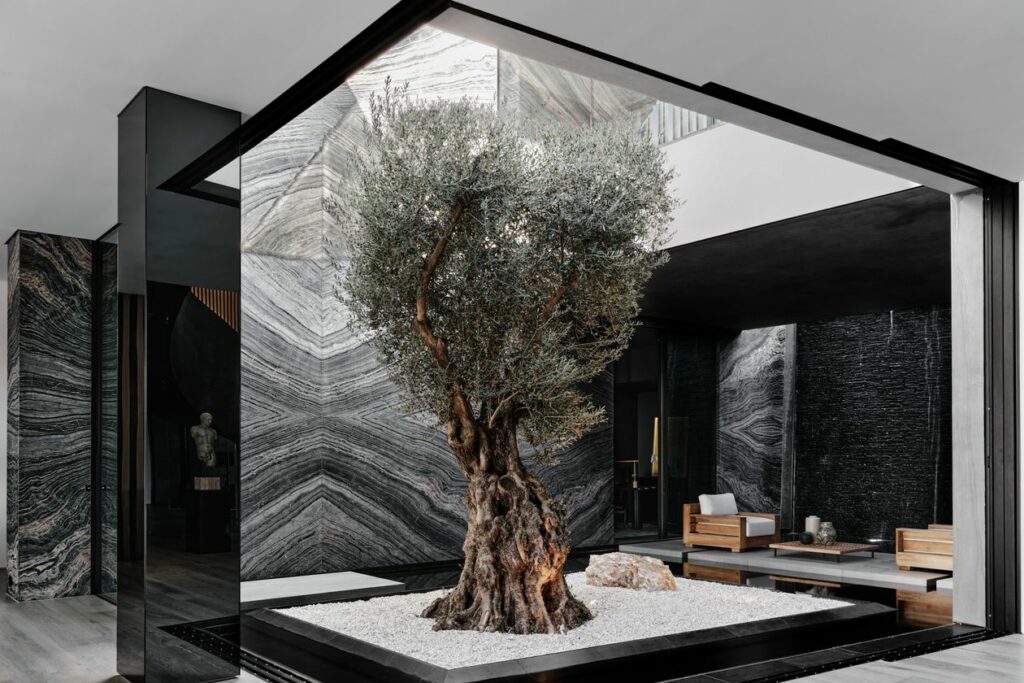
A living tree inside a building isn’t a novelty anymore — it’s an architectural decision with emotional consequences. This essay explores why trees have moved from landscaping to structure, and how architects use them to soften scale, choreograph shadow, and make modern spaces feel emotionally inhabited on day one.
At a glance: scale • shadow • calm • permanence • biophilic design, upgraded • indoor-outdoor as architecture, not decor
sometimes you need a statement tree
Some rooms have everything — and still feel like nothing. The stone is immaculate, the glass is heroic, the hardware is discreet to the point of vanishing, and yet the atmosphere refuses to arrive. Luxury has a quiet problem right now: finishes are no longer the differentiator.
A mature tree solves something materials can’t. It introduces time. Makes moving shadows. A tree adds softness to hard edges and human proportion to intimidating volume. And it gives the eye somewhere to land — and the nervous system somewhere to settle.
I’ve spent years studying how light behaves in rooms — and trees are one of the few design elements that truly move it.
Design language has finally caught up with what people already feel in their bodies. “Biophilic design” is the umbrella term for integrating nature into built environments to improve wellbeing, but the best examples are not spa-scented messaging. They are spatial intelligence: living form used as an instrument of proportion, acoustics, and light.
Rooms of Light has been circling this idea for months — that atmosphere is built, not bought — from Unavailable Is a Lifestyle to the question of what twilight actually smells like at home.
Architects have always used fire, water, and light to create “center.” The indoor tree belongs in that lineage — an anchor that is alive, not staged. It gives a large home a pulse.
A tree is also a form of editing. It interrupts the long sightline, breaks the tyranny of symmetry, absorbs sound, and makes stillness feel intentional rather than empty. In an overstimulated culture, atmosphere is the new status symbol. And trees are one of the most persuasive ways to build it.
the “trophy tree” is really a scale trick
The phrase “trophy tree” has tabloid charm, but the logic beneath it is architectural: very large houses can feel too large. A tree is a way to mitigate scale — to make big interiors feel composed rather than cavernous. It does the work a monumental artwork is often asked to do, but with less ego and more quiet authority.
This is not a residential invention. Public and institutional architecture has used interior gardens to civilize volume for decades. The Ford Foundation building in New York, designed by Kevin Roche and John Dinkeloo (1967), turns the idea into a thesis. It’s a massive, glass-enclosed atrium that functions as a public garden, landscaped with full-sized trees, shrubs, and a pool. The space reads less like an office building and more like an interior park: a model of how nature recalibrates proportion without theatricality.
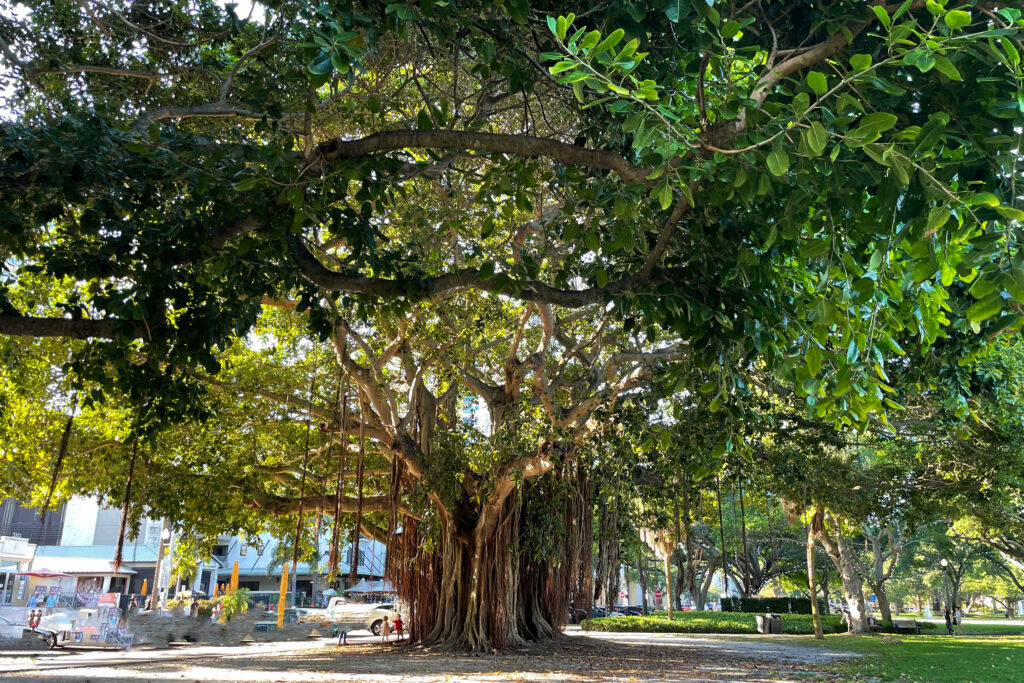
In New York, it’s also a reminder: the most luxurious square footage is often the kind that doesn’t announce itself. It breathes. This is the tree house idea, translated into luxury architecture: canopy as structure, greenery as proportion, shadow as mood.
greenery first
Some of the most compelling examples begin with an inversion: the building is designed to preserve what already exists. The tree is treated as a site condition — like topography or light — not an accessory.
Casa Corallo in Santa Rosalía, Guatemala (Paz Arquitectura, 2011) was explicitly designed to preserve the existing forest, with mature trees growing through interior living spaces, sealed by glass walls around trunks. The experience is not “plants inside.” It is architecture edited around living mass — a plan that refuses to pretend the site is blank paper.
In Austin, Texas, The Tree House (MF Architecture, 2014) centers on a large heritage oak. The structure curves around the tree, and the courtyard it creates is visible from nearly every room through floor-to-ceiling glass. Here, the tree becomes a spatial constant — a way of orienting daily life through canopy, shade, and seasonal change.
This posture carries a particular kind of contemporary authority. It reads as stewardship rather than spectacle, patience rather than immediacy. A mature tree cannot be rushed; designing around one makes time visible, and that visibility is part of the luxury.
There’s a reason this resonates in Rooms of Light: trees don’t just occupy space. They teach a room how to behave in light.

A garden with rooms, not rooms with a garden — Hotel del Parque’s interior courtyard.
we’ve seen this before
If indoor trees no longer feel eccentric, it is partly because civic spaces made the language legible first — and made it feel normal to treat the interior as a controlled climate landscape. New York has trained us to respect shadow as a design choice — a point we made directly in The Inversion of Night: Darkness as Luxury.”
In Washington, D.C., the Kogod Courtyard at the Smithsonian American Art Museum and National Portrait Gallery sits beneath an undulating glass canopy by Foster + Partners. Inside, the landscape includes two large ficus trees and other plantings that turn the vast enclosed volume into something like an outdoor plaza.
In Boston, the Isabella Stewart Gardner Museum offers an older, more theatrical version of the same idea. At the heart of the Venetian-style palazzo is a glass-topped central courtyard known for rotating horticultural displays — often featuring tall palms and lush ferns — creating a dramatic indoor garden visible from the galleries above.
Some of the most persuasive versions of this idea live in hospitality, where calm is the product. At Relais & Châteaux’s Hotel del Parque in Guayaquil, Ecuador, trees and tropical planting are incorporated into the hotel’s interior courtyards, so the building reads like a garden with rooms rather than rooms with a garden. It’s one of my favorite hotels in the world.
These precedents matter because they clarify the point: interior trees are not decoration. They are spatial strategy — a way of making scale humane and light feel inhabited.
a fabulous faux is not out of the question
The architectural idea has a parallel in collectible design: even when a tree is not living, its arboreal form still functions as an atmosphere device — line, silhouette, asymmetry, shadow.
Sebastian Errazuriz, the New York-based artist and designer, is a lodestar of this language. In his Tree Series — including the “Bilbao” and “Metamorphosis” shelves — he creates functional shelving units from fallen branches (often London Plane), re-engineering them with steam bending and complex joinery so the branch can hug a wall or wrap a corner. The raw organic structure remains, but the finish is high design. Think lacquered surfaces (often black or natural) paired with glass shelves. These pieces operate as collectible design art, typically sold through galleries such as David Gill Gallery or Salon 94, and priced in the five-to-six-figure range.
A closely related icon is Benjamin Graindorge’s “Fallen Tree” bench: a clean minimalist plank of oak that transitions into the raw chaos of branches, as if the tree is being processed into furniture in real time. The piece is part of the Centre Pompidou’s collection and is produced by the YMER&MALTA gallery.
For a more graphic, stylized interpretation, Olivier Dollé’s “Bookshelf Tree” renders the idea as an architectural silhouette. It’s a wind-swept branch structure made with high-quality birch or oak plywood and artisan veneers, hand-crafted in France and often customized for specific wall dimensions.
And for a modern, freestanding version, 21st Living Art’s “Wintertree” presents a leafless tree form in glossy lacquered wood, with branches that function as shelves. Less woodland, more gallery-white minimalism.
The through-line is not literal nature. It is the use of arboreal form to reintroduce irregularity and shadow into rooms that risk becoming too perfect. A reminder that the most elegant rooms are rarely the most symmetrical ones.
a home for new growth
The indoor tree works when it is treated as architecture — a light instrument — not as a punchline. It is biophilic design at its highest level: not decorative greenery, but living structure.
An indoor tree needs volume to breathe. It needs real daylight, or the effect turns melancholic. A tree needs systems: irrigation, drainage, maintenance access. And the owner’s humility to accept that living things are unpredictable.
Done well, the result is immediate and unforgettable. The room stops reading as a showroom and starts reading as a life.

Twilight in the courtyard: a tree house mood, grown-up.
There is also, quietly, the collector’s logic: a tree is the one element in the room that cannot be “finished.” It keeps becoming. Keeps throwing new shadows. It insists on season. And in rooms designed to look complete, that incompleteness is exactly what makes them feel true.
In the end, the indoor tree is not the new design detail. It is a declaration that luxury has moved from acquisition to atmosphere — from look to feel.
sources + further reading
- Ford Foundation — the Ford Foundation building and its 12-story interior atrium garden (Kevin Roche and John Dinkeloo, 1967).
- Smithsonian American Art Museum — the Kogod Courtyard (Foster + Partners) and its interior landscape.
- Isabella Stewart Gardner Museum — the glass-topped courtyard and rotating horticultural displays.
- Sebastian Errazuriz — the Tree Series, including the “Bilbao” and “Metamorphosis” shelves.
faqs: trees as architecture and interior design
what is an indoor tree in architecture?
An indoor tree is a living, rooted tree integrated into a building’s interior plan — typically through an atrium, courtyard, or skylit volume designed to support its growth and maintenance.
why are trees showing up inside luxury homes now?
Because trees solve for what large contemporary spaces often lack: human scale, moving shadow, softened acoustics, and a sense of permanence that finishes alone cannot provide.
is this just biophilic design under a different name?
Sometimes it is framed that way, but the most convincing examples go beyond wellness language: the tree becomes a spatial anchor that shapes proportion, circulation, and light.
what makes an indoor tree feel elegant instead of gimmicky?
Architecture. Generous volume, true daylight, disciplined sightlines, and invisible systems for irrigation and access — so the tree reads as structure, not staging.
are tree-inspired bookshelves and furniture part of the same design idea?
Yes. Works like Sebastian Errazuriz’s Tree Series translate the same impulse into objects: arboreal form becomes silhouette, shadow, and proportion inside the room, even when the “tree” is sculptural rather than living.
what is the simplest way to get the effect without placing a tree inside the house?
Design around an exterior courtyard tree framed by glass, or compose the main living space so canopy and seasonal shadow become the room’s primary ceiling — delivering the emotional effect without interior horticultural complexity.