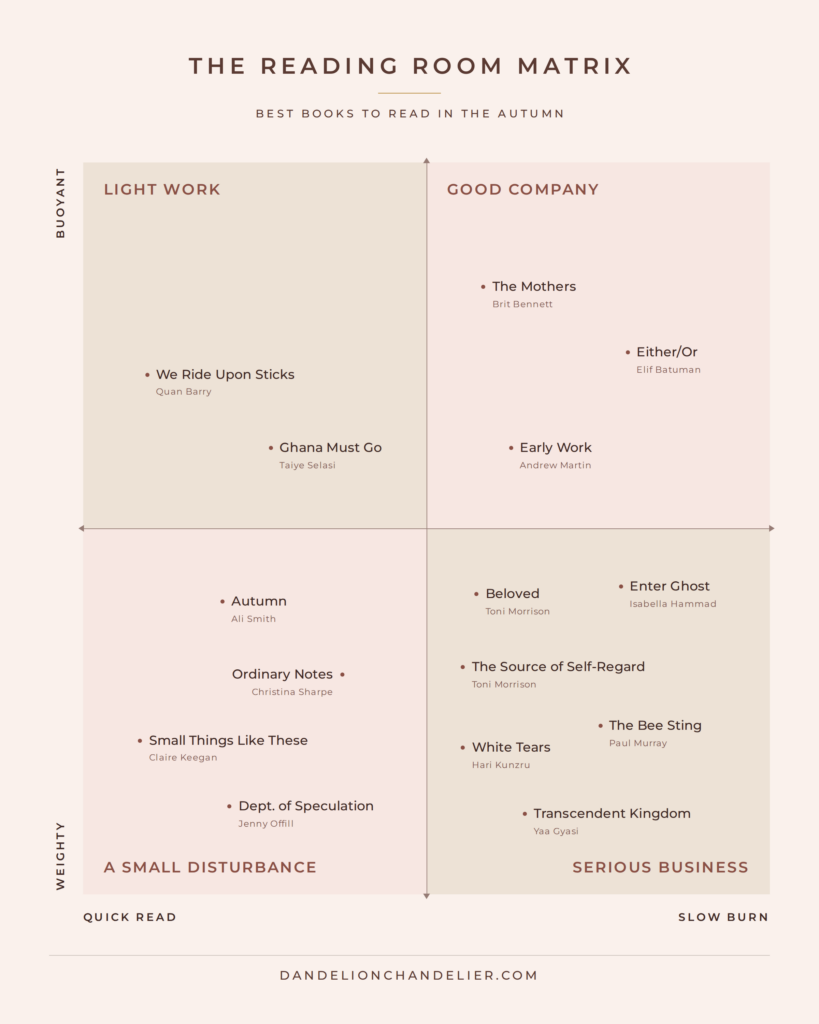
The best books to read in autumn are books about reset, haunting and reckoning: fall novels, memoirs and essays that understand sharper light, shorter days, family memory, ambition, grief, ghosts, faith and the pressure of change. This autumn reading list gathers 15 books from Dandelion Chandelier’s September, October and November Reading Room lists — the distilled best-of autumn reading list for readers who want one fall shelf that moves from re-entry to shadow to late-season clarity.
The Reading Room is Dandelion Chandelier’s curated literary salon: monthly, seasonal and thematic reading lists chosen for beauty, intelligence, emotional resonance and the mood of the moment.
For September’s reset, begin with Autumn, Early Work, Dept. of Speculation, Either/Or and The Source of Self-Regard. For October’s haunting, read Beloved, We Ride Upon Sticks, Enter Ghost, White Tears and Ordinary Notes. For November’s reckoning, finish with Ghana Must Go, The Mothers, Transcendent Kingdom, Small Things Like These and The Bee Sting.
At a glance: autumn reading list • fall reading list • September reset • October haunting • November reckoning • novels and nonfiction • 15-book best-of edit
All photography is by Pamela Thomas-Graham for Dandelion Chandelier.

A sentence of trees in late light.
what to read when edit season arrives
Autumn is not a vibe so much as a verdict. It arrives, looks around, and starts deciding what stays.
The season that gives us pumpkin can also give us clarity. The light sharpens. The calendar tightens. The old arrangements begin to show their seams. Summer’s easy permissions give way to the cooler question of what deserves attention now.
In our companion Art Lens essay on famous autumn paintings, the season appears in pigment: gold leaves, darkening paths, harvest fields, bare branches, beautiful surfaces with a deeper cut beneath them. The same is true in literature. A strong autumn reading list is rarely only about weather. It is about refinement. Illusion thinning in cooler air. Relationships, identities, ambitions and myths quietly subjected to revision.
how to read the autumn season
september: the reset
We like to think of September as the second New Year of the year: less champagne, better shoes. Its books belong to re-entry, ambition, cultural season, first coats, renewed standards and the private audit of who we intend to become next.
1. autumn by ali smith.
Ali Smith’s Autumn does not simply take place in the season. It thinks in it.
The novel moves in bright fragments: friendship, aging, political fracture, art, memory, language and the strange sensation of living through a country changing shape beneath one’s feet. Elisabeth, a young art lecturer, remains tethered to Daniel, her 101-year-old friend and surrogate father figure, as the present grows unstable and the past starts insisting on being counted.
2. early work by andrew martin.
A late-summer love affair cooling into September is one of the most honest seasonal arcs we have, and Andrew Martin’s Early Work understands the exact moment the temperature changes.
Two young writers in Charlottesville fall into each other: the chemistry is real, the ambition is real, and the small competitions that feel harmless in July start to feel like prophecy in September. It is funny, bruised, intelligent and wonderfully precise about the early lives we build before we know what they will cost.
Autumn’s first cut is often a quiet one: the realization that wanting the same thing as someone else can turn love into a ledger.
3. dept. of speculation by jenny offill.
Jenny Offill’s Dept. of Speculation is marriage written as compressed weather: sharp gusts, sudden warmth, long gray stretches and the feeling that everything important is happening in the margins.
Offill’s narrator is a writer, a wife and a mother trying to keep hold of herself while intimacy, domesticity, ambition and betrayal reconfigure the room. The form is spare, fragmented and exacting; every sentence feels like something rescued from a larger storm.
The autumn tension inside it is that nothing explodes. Things simply erode: trust, intimacy, patience, purpose. Increments too small to dramatize until one looks up and realizes the room has changed. Autumn edits like that. Not with fireworks. With subtraction.
4. either/or by elif batuman.
Either/Or is the September campus book because it is the sophomore-year book, the second-draft book, the book of return.
Selin is back at Harvard after the bewilderment of The Idiot, and now the question is no longer simply how to survive arrival. It is how to choose. Literature, sex, friendship, travel, parties, taste, experience, embarrassment, desire: Batuman turns the education of a young woman into something comic, awkward, philosophical and quietly devastating.
5. the source of self-regard by toni morrison.
If September is back-to-school season, let Toni Morrison be the professor.
The Source of Self-Regard gathers essays, speeches and meditations across four decades, including reflections on literature, language, politics, race, imagination, Martin Luther King Jr., James Baldwin and the dead of September 11. It is not a book to rush. It is a book to sit with at the hour when the day has cooled and the mind is finally ready to listen.

Fall with room to think.
october: the haunting
October is not horror. October is haunting. Its books do not merely frighten; they reveal. Ghosts, witches, songs, archives, bodies, houses and histories return because something has been denied language, burial, justice or love.
6. beloved by toni morrison.
Toni Morrison’s Beloved is the essential American ghost story because the ghost is not a seasonal flourish. She is history. She is love. She is violence. She is memory returning in a form no one can domesticate.
Sethe has escaped slavery, but she has not escaped what slavery did to her, to her children, to her body, to her idea of protection, to the house at 124. Morrison refuses the tidy division between the living and the dead. The past is not “back there.” It is in the room, at the table, in the voice, in the milk, in the scar, in the name.
7. we ride upon sticks by quan barry.
Quan Barry’s We Ride Upon Sticks is October with a varsity jacket and a wicked grin. In 1989, the Danvers Falcons field hockey team, from Danvers, Massachusetts, where the Salem witch trial accusations began, decide that ordinary effort may not be enough. Perhaps dark powers might help. Perhaps an Emilio Estevez notebook can become an instrument of destiny.
The result is one of the funniest, smartest, most subversively generous witch novels in recent memory: part team comedy, part feminist coming-of-age story, part local-history séance, part glorious tribute to teenage girls who want something and are tired of being told to want it quietly.
8. enter ghost by isabella hammad.
Isabella Hammad’s Enter Ghost belongs in autumn by title and by temperament. Sonia, an actor living in London, returns to Palestine and becomes involved in a West Bank production of Hamlet. Theater, return, family, language, stagecraft, ghosts: the season could hardly ask for more.
But the novel’s power lies in how it understands performance under pressure. Who is allowed to speak? What does it mean to rehearse a tragedy while living inside one? When does acting become witness, and when does art become a way of standing still long enough to be seen?
9. white tears by hari kunzru.
Hari Kunzru’s White Tears begins in contemporary New York with two young white men obsessed with sound, authenticity and old blues recordings. Then a fake musical discovery turns out to have a history, and the novel moves into something darker: ghost story, murder mystery, cultural indictment and reckoning with the exploitation of Black music in America.
This is one of the strongest autumn books on the shelf because it understands haunting as reverberation. A voice is recorded. A song circulates. A collector wants what he cannot own. The past returns not as mist, but as sound. A ghost story, with better speakers.
10. ordinary notes by christina sharpe.
Christina Sharpe’s Ordinary Notes belongs to autumn’s deepest register. It is a book of fragments, images, memory, criticism, grief, Black life, beauty, violence and attention. It does not behave like conventional nonfiction because the world it studies has not behaved conventionally toward the people inside it.
Sharpe writes in notes because notes can hold what linear argument sometimes flattens. A photograph. A family memory. A work of art. A sentence. A wound. A question. An image one cannot stop seeing.

A blue door in yellow weather.
november: the reckoning
November gathers the consequences. Family, inheritance, faith, grief, mothers, daughters, estrangement, money, care, performance, homecoming and early-winter clarity. November does not haunt in the same way October does. It asks what the haunting has cost.
11. ghana must go by taiye selasi.
Taiye Selasi’s Ghana Must Go is a homecoming novel with international voltage. Kweku Sai, a brilliant Ghanaian surgeon who built and lost a life in America, dies suddenly in Ghana. His estranged family — wife, sons, daughters, each carrying the private weather of abandonment, excellence, shame and longing — is drawn back toward one another.
This is a novel about diaspora, yes, but also about the myth of the exceptional family. The Sais are beautiful, gifted, wounded, scattered. They have the kind of intelligence that can become armor and the kind of pride that makes apology feel impossible until grief rearranges the room.
12. the mothers by brit bennett.
Brit Bennett’s The Mothers begins with young love, grief, pregnancy, secrecy and the chorus of older church women who watch, judge, narrate and remember. Nadia Turner, mourning her mother’s suicide, becomes involved with Luke, the pastor’s son. Their choices ripple outward through friendship, faith, ambition and the women they become.
The title does a great deal of work. The mothers are literal, absent, imagined, communal, moral and mythic. Bennett writes beautifully about the lives young women might have lived, the selves they abandon and the particular ache of being watched by people who think they know the whole story.
13. transcendent kingdom by yaa gyasi.
Yaa Gyasi’s Transcendent Kingdom is one of the clearest late-autumn novels on the shelf. Gifty, a Ghanaian American neuroscience PhD candidate at Stanford, studies reward-seeking behavior in mice while trying to understand her brother’s addiction, her mother’s depression, her childhood in an evangelical church and the faith she has both lost and not entirely escaped.
This is a novel of grief and discipline, science and prayer, ambition and loneliness, family love and the terrible inadequacy of explanation. Gifty wants knowledge to do what knowledge can do. She also knows, painfully, what it cannot.
14. small things like these by claire keegan.
Claire Keegan’s Small Things Like These is slim, winter-lit and morally radiant. Set in an Irish town in 1985, it follows Bill Furlong, a coal merchant and father, as he encounters a truth connected to the local convent and must decide whether to look away or act.
The book is almost shockingly quiet. That is part of its power. Keegan understands that moral courage is not always dramatic in the moment. Sometimes it is a small choice made against the grain of complicity, reputation, convenience and fear.
15. the bee sting by paul murray.
Paul Murray’s The Bee Sting is a family novel with weather in every wall: economic anxiety, marital fracture, adolescent pain, climate dread, denial, accident, memory and the terrible comedy of people insisting everything is fine while the structure is already groaning.
The Barnes family is coming apart in an Ireland shaped by the aftermath of financial collapse, and Murray lets everyone speak: parents, children, the past, the future, the part of the family story everyone thinks someone else is managing. The result is expansive, funny, tragic and emotionally ruthless in the best way.

The weather turns intimate.
final thoughts: edit season
Autumn is not here to entertain us. It is here to refine us. The light shortens. The noise recedes. The season does not ask what one wants. It asks what one is keeping.
That is why the best fall books do more than take place in autumn. They understand why the season alters perception. They make ambition less flattering, memory less optional, family less sentimental, and beauty more exacting. They know the difference between mood and meaning.
September returns us to the world. October asks what has been waiting in the dark. November asks what we will do now that we know. Together, they make autumn the most literary season of the year: not because it is pretty, though it is. Because it has standards.
for additional seasonal reading this fall
Autumn has several side doors, each worth opening. If September’s back-to-school atmosphere is the part of the season that pulls you in most strongly, continue to our Reading Room guide to the best campus novels. If the real drama is the return to work, our edit of the best books about work life follows the office, the service job, the paycheck, the burnout and the moral weather of making a living. And when November brings Veterans Day and Armistice Day into view, our Veterans Day Reading Room carries the books about war, soldiers, service and remembrance in their own proper light.
faqs:
what makes a good autumn reading list?
A strong autumn reading list should include books that move through the season’s emotional arc: September reset, October haunting and November reckoning. This autumn reading list includes Autumn by Ali Smith, Beloved by Toni Morrison, Enter Ghost by Isabella Hammad, Ordinary Notes by Christina Sharpe, Ghana Must Go by Taiye Selasi, Transcendent Kingdom by Yaa Gyasi, Small Things Like These by Claire Keegan and The Bee Sting by Paul Murray.
what are the best books to read in autumn?
The best books to read in autumn include those about transition, memory, ambition, ghosts, family, faith, grief, inheritance, moral clarity and seasonal change. The best fall books do not simply mention leaves or weather. They understand the emotional intelligence of autumn: what changes, what returns, what gets edited and what refuses to disappear.
what should i read in september, october and november?
Read September books for reset and re-entry, October books for hauntings and shadow, and November books for homecoming and reckoning. For September, begin with Autumn and Either/Or. For October, read Beloved and Enter Ghost. For November, read Ghana Must Go, Transcendent Kingdom and Small Things Like These.
what are the best fall novels?
The best fall novels include Autumn by Ali Smith, Early Work by Andrew Martin, Either/Or by Elif Batuman, Beloved by Toni Morrison, We Ride Upon Sticks by Quan Barry, Enter Ghost by Isabella Hammad, White Tears by Hari Kunzru, Ghana Must Go by Taiye Selasi, The Mothers by Brit Bennett and The Bee Sting by Paul Murray.
what nonfiction books are good to read in autumn?
Good nonfiction books to read in autumn include The Source of Self-Regard by Toni Morrison and Ordinary Notes by Christina Sharpe. Both books carry the season’s deeper intelligence: moral imagination, memory, language, race, history, attention and the discipline of seeing clearly when the year begins to narrow.
how is this fall reading list different from the monthly reading room lists?
This fall reading list is the distilled best-of from Dandelion Chandelier’s September, October and November Reading Room posts. September owns the reset, October owns the haunting, and November owns the reckoning. This autumn roundup gathers five books from each month into one seasonal shelf.
why is autumn called edit season?
Autumn is edit season because it brings clarity, structure and selection. After summer’s ease, fall asks what deserves to stay: which habits, ambitions, relationships, stories and obligations still hold. The best autumn books mirror that process by sharpening motives, returning buried histories and forcing emotional honesty.