Thanksgiving, Beautifully Held is Dandelion Chandelier’s guide to creating a Thanksgiving that feels generous, personal and beautifully considered without turning the holiday into a production. For hosts and guests alike, this is where we gather the table, flowers and candlelight; houseguest provisions; books and what to wear; the right gift for the host; paper, gratitude and the words afterward. The goal is not more Thanksgiving. It is better judgment about what the day actually needs.
The Gathering Hour is Dandelion Chandelier’s ongoing series on luxury hosting and entertaining — elevating tables, flowers, guest rituals, and shared moments into the modern art of welcome.
At a glance: the table • flowers and candlelight • houseguests • provisions • books • what to pack • what to wear • host gifts • paper and gratitude • ask Vale
All photographs by Pamela Thomas-Graham for Dandelion Chandelier.
thanksgiving is the room autumn has been preparing
Thanksgiving 2026 falls on Thursday, November 26. Which sounds simple enough until one remembers that the holiday is never only Thursday, never only dinner, and certainly never only turkey. It is arrival day and the coat at the door. It is the guest room with a working lamp, the flowers that should not block the person one is trying very hard to forgive, the scent in the hallway, the note beside the plate, the book on the nightstand, the pie that tastes mostly of memory, the thank-you afterward, and the complicated weather of returning home, welcoming others into yours, or making a different choice altogether.
Thanksgiving is not a menu. It is a room under pressure. And the most beautiful version of the holiday is not the one that performs perfection. It is the one that holds.
november is go time
Autumn at Dandelion Chandelier begins in the city: museums reopening with force, books getting heavier, dinner becoming culture again, coats speaking before we do, paper returning to the desk, and lamplight becoming useful after months of outdoor ease. By November, all of that sharpens into Thanksgiving.
Style, culture, home and gifts stop behaving like separate categories and sit down at the same table. Clothes matter because people are arriving. Books matter because there is a guest room, a sofa and a morning after. Flowers change the room before anyone says a word. Paper gives gratitude somewhere to land. A host gift tells the person who did the work, without requiring a speech, that someone noticed.
Thanksgiving, beautifully held, is not about overproducing the day. It is about editing the day so that it can breathe: a table that can hold memory; a house that smells like welcome; a pantry that understands people wake at different hours; a wardrobe that survives travel, family weather, dinner and old friends; a gift that does not create another assignment; and a note that names the labor. Gratitude is allowed to be specific, adult and blessedly free of decorative pumpkins with vocabulary.
start here: the thanksgiving 2026 edit
secrets of the thanksgiving table.
Begin with the table, where the holiday declares its intelligence. Secrets of the Thanksgiving Table is our guide to memory, inherited pieces, candlelight, seating, serving pieces and the small revelations that make a table feel personal rather than produced.
thanksgiving in bloom.
Thanksgiving in Bloom covers flowers for the table, entry, sideboard, powder room and the rooms before and after dinner: what lasts, what smells too strong, what blocks the view and what understands the hour.
in light of thanksgiving.
In Light of Thanksgiving is the room-by-room guide to scent and candlelight: where fragrance belongs, where it does not, and how to make the house feel warm without asking dinner to compete for attention.
extra fine: provisions for people staying over.
Extra Fine: Provisions for People Staying Over covers the coffee, tea, sparkling water, fruit, cheese, chocolate and small house signatures that allow guests to wake early, stay up late or help themselves without asking permission.
the reading room: a literary feast for thanksgiving.
The Best Books to Read for Thanksgiving: A Literary Feast gathers books about family, appetite, gratitude, inheritance, memory and the complicated beauty of gathering. Thanksgiving is memory disguised as ritual, and books understand that better than most centerpieces.
what to pack for thanksgiving weekend and the hallway test.
What to Pack for Thanksgiving Weekend solves the four-day suitcase. The Hallway Test: What to Pack When Staying at Someone Else’s Home solves what happens after the coat comes off, when clothes have to work in actual rooms among actual people.
the fall paper trail and when the words are hard.
The Fall Paper Trail is our edit of cards, envelopes, ink, place cards and enclosure notes. When the Words Are Hard handles the language itself, including the thank-you afterward when “lovely evening” is nowhere near enough.
here’s what to bring the thanksgiving host.
What to Bring the Thanksgiving Host is the dedicated guide to giving on Thanksgiving itself: something for the person, not the production. What Autumn Guests Bring is its broader companion for dinners, weekends and other fall invitations.
Once the broad shape of the weekend is clear, ask Vale to edit Thanksgiving around your actual house, guest list, travel plans, wardrobe, dietary realities and emotional weather. A generic Thanksgiving is manageable; a specific one is where judgment becomes useful.
the table can hold the day
A Thanksgiving table should not merely tell a story. It should hold one. A table that tells a story can become a monologue: too many objects, too much theme, too much seasonal punctuation. A table that holds a story gives the room somewhere to place its memory.
That might mean the good dinnerware that still makes someone nervous, silver that has not been polished to within an inch of its ancestry, mismatched glasses because life happened, or a place card that makes the seating feel considered rather than tactical. Add candlelight low enough for people to see one another and one object that belongs to the household rather than the algorithm, and the table begins to feel less decorated than inhabited.
memory and revelation.
A Thanksgiving table is never entirely present tense. Even when everything is new — new apartment, new partner, new city, new china bought because one finally refused the chipped plates — the table carries what came before. Use a platter from someone’s mother, a bowl bought on a trip, candlesticks found upstate, or a textile from Oaxaca, Kyoto, Lagos, Istanbul, Marrakech, Jaipur, Brooklyn or Paris. The table does not need a thesis; it needs evidence of a life.
Then leave something to discover. A handwritten note, a printed menu, a small object, a place name written beautifully or a piece whose significance becomes clear only after someone asks can give the table a private layer beneath the visual one. The best tables do not announce themselves all at once. They reveal themselves over dinner.
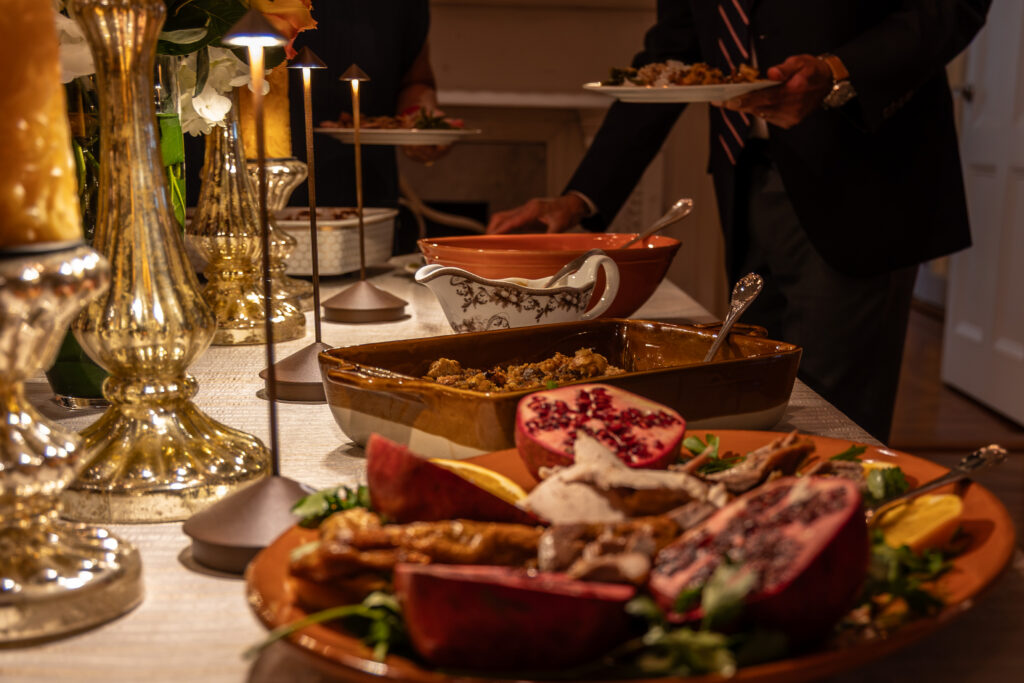
The table has work to do.
the table as choreography.
The beautiful table must still allow people to eat. Keep the flowers low, the candlelight flattering, the serving pieces within reach and the color story disciplined enough that the food still looks like the point.
Seat people with imagination, too. A Thanksgiving table is not merely a seating chart; it is a social instrument. Who can draw someone out, who needs relief from whom, who might delight one another if given the chance — these are design decisions every bit as consequential as the candlesticks.
flowers, scent and light
A Thanksgiving house begins speaking before the host does. Flowers establish scale and mood, scent establishes atmosphere, and light determines whether the room feels generous, theatrical, anxious or intimate. All three are powerful enough to require restraint.
flowers that know the room.
Thanksgiving flowers have to survive kitchen heat, sideboard crowding, changing light, crowded plates and a long meal without blocking a face or demanding attention halfway through dinner. The entry can take something more architectural; the table requires lower instincts. The powder room can carry a small flourish; the sideboard can tolerate a little drama.
Thanksgiving in Bloom goes deeper into color, proportion, longevity and placement. The rule underneath it all is simpler: flowers should change the room before anyone notices the arrangement itself.
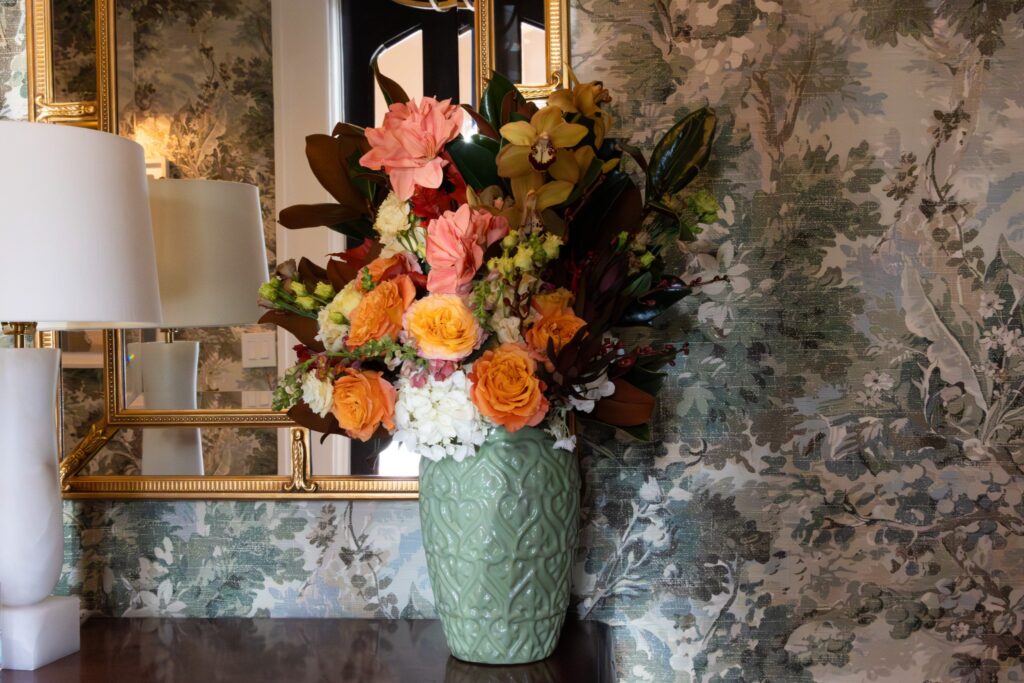
Flowers that know the room.
scent that knows when to leave the table alone.
The Thanksgiving house should smell like welcome, not dessert cosplay. Beeswax, cedar, bitter orange, black tea, polished wood, coffee, cardamom and woodsmoke all have their place, as does the honest evidence of something browning properly in butter.
Scent can live beautifully in an entry, hallway, powder room or guest room. At the table, however, the food has earned the right to speak. In Light of Thanksgiving covers the distinctions, along with the equally important question of how much candlelight is atmospheric and how much is simply too much fire near the napkins.
candlelight that flatters the evidence.
Thanksgiving wants layers of light rather than one blazing source from above: lamps, low candles, a glow in the hallway, enough light in the guest room to read and enough in the dining room to see the person opposite. A well-lit Thanksgiving does not make the room more impressive. It makes everyone in it look as though arriving was a good idea.
the house should already know
Houseguest hospitality is not interrogation. It is anticipation. People staying over should not have to ask for every small comfort: where the coffee is, whether there is tea, if they may help themselves to sparkling water, where a phone can be charged, which towel is theirs or what happens in the morning. The house should already know.
That does not mean filling every available surface with amenities. It means making the necessary things easy to find and establishing, quietly, that a guest can be comfortable without constantly seeking permission. The real luxury is not abundance. It is the feeling that someone thought ahead.
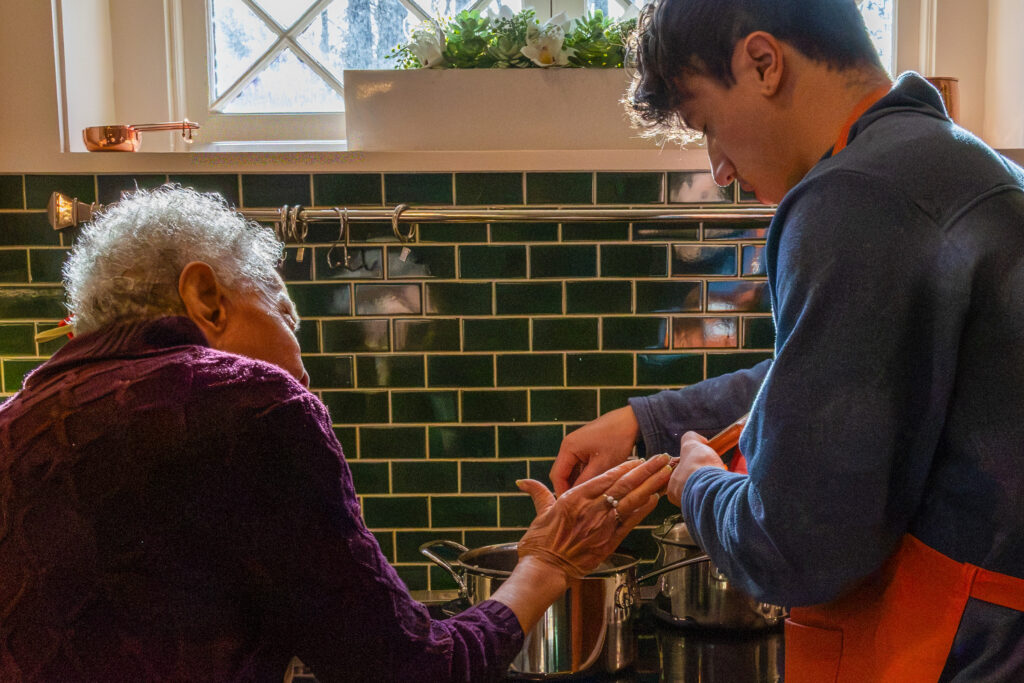
Someone thought ahead.
provisions without performance.
The great Thanksgiving pantry is less about quantity than permission. Good coffee, proper tea, sparkling water, fruit, yogurt, granola, cheese, crackers, chocolate, something salty and something sweet are usually enough, along with sufficient cocktail and nonalcoholic options that no one has to explain what they are or are not drinking.
One house signature adds personality: the tea everyone remembers, a particular chocolate, a remarkable local pastry or the excellent crackers no one can identify. Extra Fine: Provisions for People Staying Over is the full edit, and if Thanksgiving sends you deeper into the larder, this is also a fine week for finishing salt, olive oil, the spice drawer and The Pie You Remember (Not the One You Actually Had). At some point, however, the pantry must stop auditioning and let Thanksgiving happen.
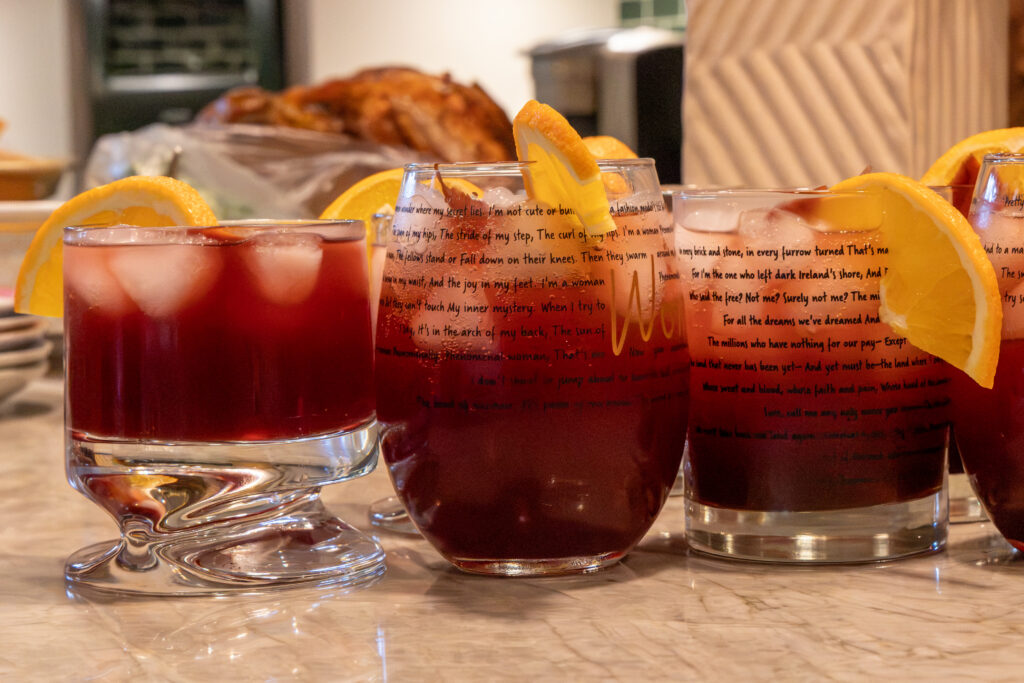
Ready before anyone asks.
the morning after.
The morning after Thanksgiving is part of the holiday, and households approach it differently. Someone runs, someone reads, someone sleeps until noon, and someone has been awake since six trying not to make this anyone else’s problem.
Make self-service obvious. Show people where the coffee lives, put mugs where they can be seen and have food available that does not require a host to wake up and perform breakfast. Hospitality can be as simple as allowing people to fend beautifully for themselves.
the guest room.
Water, a glass, tissues, a charging point, a reading lamp that actually works, a small dish for jewelry, a place for a bag and a hook will do more than elaborate amenities. Add a book if the guest is a reader, perhaps chocolate if it feels right, and enough surface area for a watch, phone, glasses and the small emotional wreckage of travel.
The elegant host also provides privacy without making a ceremony of it: a door that closes, towels where they can be found, light by the bed and a way to be alone. The elegant houseguest, in turn, does not pretend to be invisible. Somewhere between hovering and disappearing is the grace of a house that works.
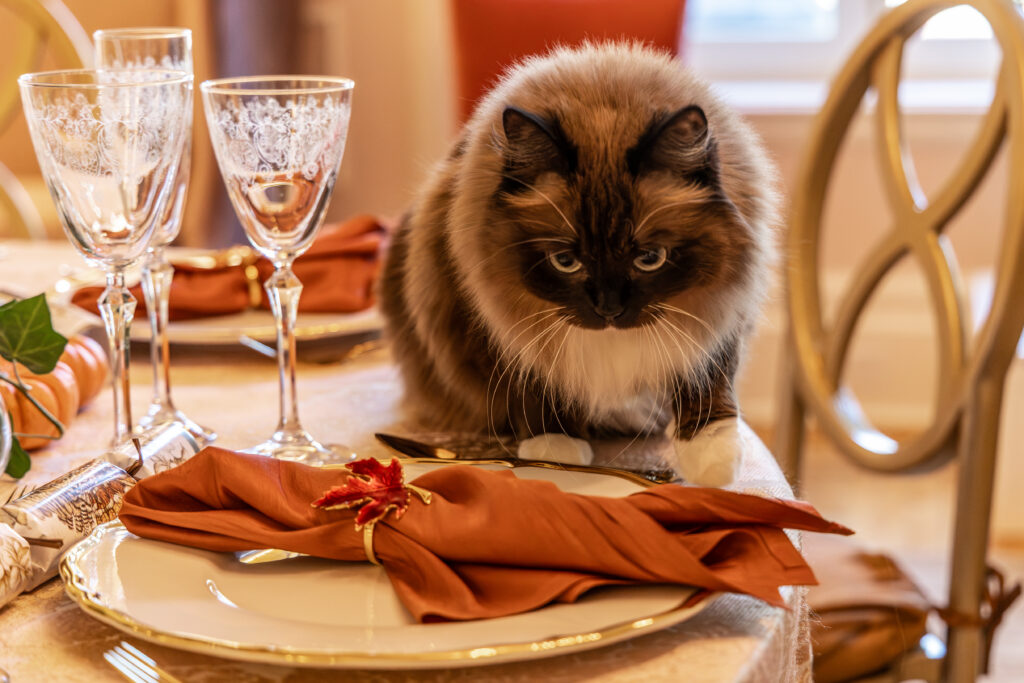
The seating chart is flexible.
books for what the room cannot quite say
Thanksgiving is secretly one of the great reading holidays. There is the airport book, the train book, the guest-room book and the book read on the sofa while someone else watches football with the emotional commitment of a litigator. There is also the book that understands family not as a theme but as a weather system.
The Best Books to Read for Thanksgiving: A Literary Feast gathers books about appetite, inheritance, memory, gratitude and the strange tenderness of people trying again. The best Thanksgiving book can survive an airport delay, offer company in a guest room and suit the reader rather than merely photograph well beside the flowers.
It need not be earnest. Gratitude is braided with obligation, delight, grief, appetite, fatigue, irritation and tenderness, and Thanksgiving literature is more interesting when it understands the whole knot.
what to wear when the weekend has plot
Thanksgiving weekend is several scenes disguised as one holiday: the airport or train, the arrival, dinner, the kitchen, perhaps old friends, the walk someone proposes just as you have become comfortable and, finally, the journey home. Clothes have to move through all of it without requiring their own logistics department.
That is why Thanksgiving dressing has two distinct problems. What to Pack for Thanksgiving Weekend solves what goes into the bag. The Hallway Test: What to Pack When Staying at Someone Else’s Home solves what happens once everyone is under the same roof.
the suitcase edit.
A good Thanksgiving suitcase anticipates changes of scene rather than individual outfits: a coat that behaves, one excellent knit, trousers with structure, something polished enough for dinner, shoes that can move and enough layering intelligence to survive climate systems both meteorological and familial.
The point is not to pack for a family holiday as though one were staging a limited series. It is to arrive composed, have enough range for the weekend and go home still recognizably oneself. What to Pack for Thanksgiving Weekend is the full Carry-On Couture edit.
the hallway test.
The hallway is where the theory meets the house. The coat comes off, someone needs help, there is a bag in one hand and perhaps a bottle in the other, and the shoes have about thirty seconds to reveal whether they were a sound decision.
For the host, the question is whether the outfit can answer the door, move through the kitchen, sit at the table and stand longer than intended while still looking deliberate. For the houseguest, it is whether one can arrive gracefully, offer help, move comfortably through the rooms and go for the walk without giving the impression that the outfit requires more care than its wearer.
The Hallway Test is not about dressing down. It is about dressing with enough intelligence for real rooms. And because Thanksgiving is emphatically an arrival holiday, The Coat Speaks First is a useful companion; Maroon Is Not Burgundy remains insurance against allowing “autumnal” to become an entire color strategy.
the gift is for the host
A Thanksgiving host gift should recognize the labor without adding to it. At Thanksgiving, do not give the production another ingredient. Give the person who produced it something for themselves.
The dinner is handled. The table is handled. The flowers are handled. A Thanksgiving host does not need another object requiring refrigeration, plating, arranging or an immediate decision about where in the house it ought to live.
Think instead about what the host might enjoy when the work is over: a book chosen for them rather than the coffee table, excellent chocolates intended to be hidden rather than circulated, something restorative, something warm, a small private luxury or something useful for the weeks ahead. A gift that looks toward December can be particularly lovely, because Thanksgiving disappears overnight and Christmas immediately moves into the foreground.
For someone staying several days, the scale may rise slightly, but the principle does not change. This is what separates What to Bring the Thanksgiving Host from What Autumn Guests Bring: a fall dinner may welcome flowers or something for the pantry, while Thanksgiving already has food, flowers and certainly a table. Give to the person who made the day possible, remembering that sometimes the most thoughtful gift arrives afterward.
paper, gratitude and the words afterward
Paper is not nostalgia. It is social architecture. Before dinner, it tells people they were expected through an invitation, a place card, a guest-room note, perhaps a printed menu or a handwritten line beside a book. At the table, paper can turn logistics into grace; afterward, it becomes gratitude.
the fall paper trail.
The Fall Paper Trail is the autumn stationery edit: cards, envelopes, ink, place cards, enclosure notes and the printed objects that slow a gesture down long enough for it to mean something. A place card is not fussy when it solves the room, a menu is not theatrical when it becomes a memory, and a guest-room note is not excessive when it saves someone from having to ask a question the house could have answered.
the thanksgiving thank-you.
The thank-you after Thanksgiving should name what happened, and not merely the food. Name the work, the welcome, the room or the thing the host did that another guest might not have noticed: thank you for making the table feel so warm; thank you for putting me in the room where the morning light is kind; thank you for remembering what I drink; thank you for making the day feel easy when I know it was not.
The words do not need to be elaborate; they need to be exact. When the Words Are Hard is the guide for moments when a formula will not do, while The Note Is Part of the Gift makes the companion point that sometimes the object is correct but the words are what make the gesture land.
Gratitude is attention made visible: specific, adult attention that notices who cooked, traveled, made room, remembered, tried, stayed, left gracefully and made the day feel less like a performance and more like a room one could finally exhale in.
ask vale before thanksgiving becomes a second job
Ask Vale when Thanksgiving begins behaving like a beautiful avalanche: when the weekend includes an airport, one serious dinner, a kitchen, an old friend and one family photograph you did not consent to but will apparently be in forever; when the host outfit has to survive the doorbell, kitchen, table and after-dinner walk; or when the host has excellent taste and no obvious needs.
Ask how to seat a table with strong personalities and fragile alliances, what book belongs in the guest room, what to write afterward when the host did more than anyone saw, how to make the house feel warm without making it smell like pie, what provisions to keep on hand for people staying over and what to skip entirely. This is not search. It is editing, and Thanksgiving, perhaps more than any other fall ritual, rewards the better edit.
the final edit
Thanksgiving puts a room under pressure. People arrive carrying appetite, memory, expectation, affection, history and luggage, sometimes in roughly that order. The work of hospitality is not to make all of that disappear. It is to make a room generous enough to hold it.
The goal is not a perfect holiday. The goal is a holiday beautifully held.
faqs:
what is Thanksgiving, Beautifully Held?
Thanksgiving, Beautifully Held is Dandelion Chandelier’s Thanksgiving 2026 hub in The Gathering Hour. It gathers our guides to the table, flowers, candlelight and scent, houseguests, provisions, books, Thanksgiving weekend dressing, host gifts, paper and gratitude into one editorial starting point.
where should I start if I am hosting Thanksgiving?
Start with Secrets of the Thanksgiving Table for the table, Thanksgiving in Bloom for flowers, In Light of Thanksgiving for scent and candlelight, and Extra Fine: Provisions for People Staying Over if guests are spending the night. Then read The Hallway Test for what to wear when the host has to move from doorway to kitchen to table without changing costume.
how should I prepare my home for Thanksgiving houseguests?
Prepare the house around anticipation rather than abundance. Make water, towels, charging points, a working reading light, Wi-Fi information and basic breakfast provisions easy to find, so guests can wake early, get a drink, make coffee, charge a phone or spend time alone without asking permission for every small comfort.
what should I bring the Thanksgiving host?
Bring something for the host rather than for the Thanksgiving production. A personal book, excellent chocolates, a restorative luxury or something useful for the weeks ahead is often more thoughtful than food, flowers, table décor or another object the host must manage while dinner is underway. What to Bring the Thanksgiving Host offers the full edit.
what should I wear for Thanksgiving weekend?
Use two strategies. What to Pack for Thanksgiving Weekend handles the suitcase: travel, dinner, weather, old friends and the return trip. The Hallway Test: What to Pack When Staying at Someone Else’s Home handles the rooms themselves, where clothes need to greet, move, help, sit, walk and survive several days of actual life.
how do I make the house feel elegant for Thanksgiving?
Edit for welcome rather than theme. Use low flowers, layered warm light, restrained fragrance away from the table, useful provisions, good paper and a guest room that anticipates basic needs. The most elegant Thanksgiving house feels collected, personal and calm enough that the people remain more important than the décor.
what should I read or give a reader for Thanksgiving weekend?
Read The Reading Room: A Literary Feast for Thanksgiving for novels, memoirs, essays and food writing about family, appetite, inheritance, memory and gratitude. The best Thanksgiving book is one that suits the reader and the emotional weather of the weekend — absorbing enough for travel, companionable enough for a guest room and never assigned like homework.