
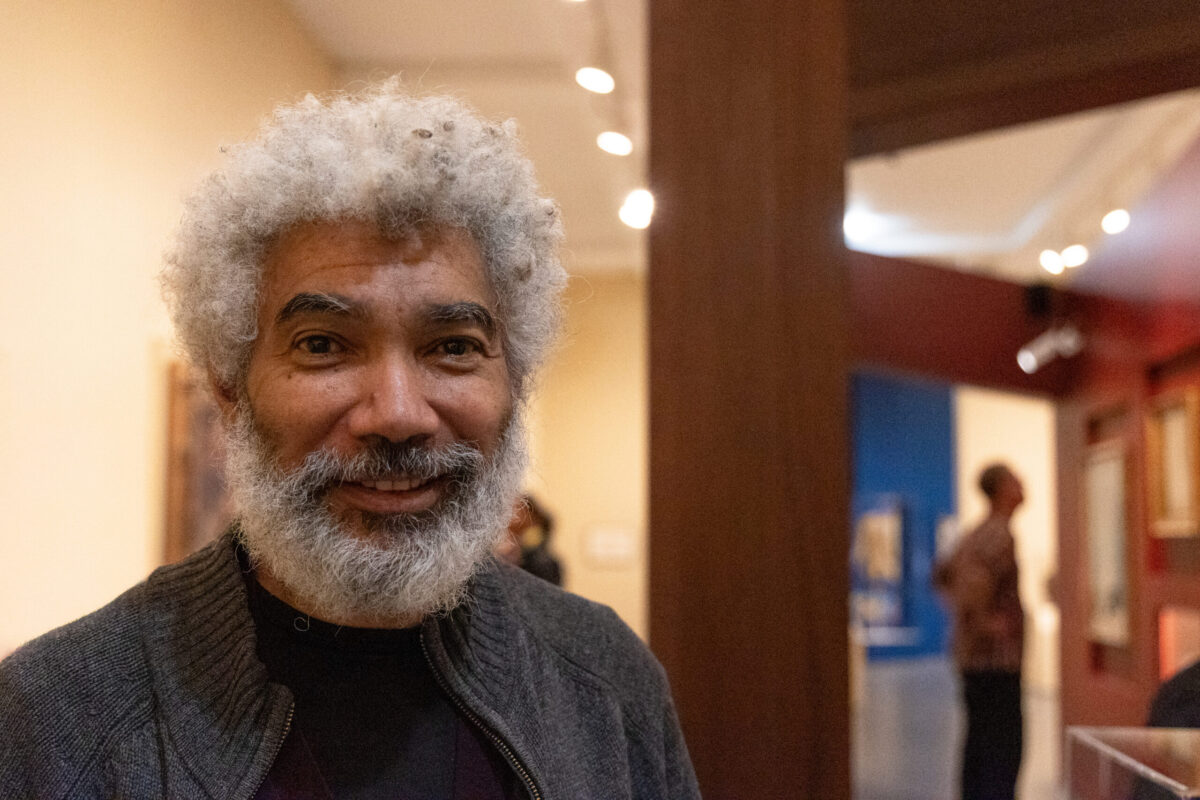
Fred Wilson and the Black Mirror
Portraits of Influence is Dandelion Chandelier’s ongoing series of profiles and interviews with cultural leaders shaping art, business, fashion, and modern luxury.
Fred Wilson is the artist museums cannot quite absorb, which is exactly the point.
A Bronx-born, Manhattan-based conceptual artist, Wilson has spent more than four decades making museums reveal what they have hidden in plain sight: the racial codes, silences, omissions, theatrical gestures, and power arrangements that shape how culture is displayed. His work is not loud. It is worse, in the best possible way: precise. A label shifts. A chandelier turns black. A mirror refuses to flatter. Suddenly the room has changed its mind.
I met Wilson at the Brooklyn Museum and saw his Iago’s Mirror installed in the American Art galleries as part of Toward Joy: New Frameworks for American Art — the museum’s sweeping reinstallation of American art through Black feminist and BIPOC frameworks. The encounter revealed not only Wilson’s power as an artist, but how art-world power actually moves.
At a glance: Fred Wilson • Iago’s Mirror • Brooklyn Museum • Toward Joy • Murano glass • institutional critique • Black curatorial power • American art reimagined
All photography in this post is by Pamela Thomas-Graham for Dandelion Chandelier.
fred wilson and the museum as mirror
Fred Wilson was born in the Bronx in 1954. Before becoming one of the defining artists of institutional critique, he worked inside museums: as an educator, an administrator, a curator, and a maker who understood that the museum is never merely a room full of objects.
That matters.
Wilson’s art has always had the unnerving authority of someone who knows the building from the service corridor as well as the front entrance. He understands that museums are not neutral containers. They are stages. Systems. They tell stories not only through what they display, but through what they store, omit, isolate, elevate, caption, polish, and ignore.
His method is deceptively simple: he rearranges objects, images, symbols, and historical fragments so that the suppressed narrative becomes impossible not to see. He does not necessarily raise his voice. He changes the lighting. Changes the adjacency. Changes the terms of the encounter.
That is enough.
The institution begins to speak.
Wilson’s practice also belongs in conversation with our essay on Black leadership in the art world, where the question is not only who makes the work, but who has the authority to acquire it, fund it, preserve it, and bring it into view.
why mining the museum changed american art
Wilson’s breakthrough came with Mining the Museum, the 1992–93 installation at the Maryland Historical Society in Baltimore, organized with The Contemporary. It remains one of the landmark exhibitions in contemporary American art — and one of the most influential acts of museum critique of the late twentieth century.
The genius of Mining the Museum was that Wilson did not import a political argument from outside. He used the museum’s own collection against its habits of memory.
Elegant silver vessels were placed near slave shackles. Antique chairs were arranged around a whipping post. Objects that had been separated by category, class, aesthetics, or curatorial comfort were brought into newly charged proximity. The result was not a lecture. It was a room suddenly breathing differently.
The controversy was inevitable because Wilson’s intervention exposed a civic fantasy: that historical collections merely preserve the past. In fact, collections arrange power. They decide whose suffering becomes background, whose wealth becomes beauty, whose labor disappears into the gleam of a surface.
For those who love museums, this is not an argument against them.
It is an argument for taking them seriously.
Wilson insists that museums matter enough to be held accountable.
That question — what institutions train us to see, and what they allow to remain just outside the frame — becomes even sharper in our visit to Richmond Barthé’s Exodus and Dance at Kingsborough Houses, where a masterpiece of Black modernism stands not in a museum, but in public life.
That question — what institutions teach us to see, and what they allow to remain in the background — also runs through In Brooklyn’s War Monuments, Black Men Are Cast in the Background, our rain-soaked look at Black representational figures hidden inside Brooklyn’s historic war monuments.
guarded view and the politics of being seen
One of Wilson’s best-known works, Guarded View from 1991, is in the collection of the Whitney Museum of American Art. The work consists of four Black headless mannequins dressed in museum guard uniforms from four New York institutions: The Metropolitan Museum of Art, The Jewish Museum, The Museum of Modern Art, and the Whitney.
It is a devastatingly elegant piece.
Museum guards are everywhere in cultural life and, too often, treated as invisible. They protect the objects, manage the room, watch the public, and are watched only when they are perceived as interrupting someone else’s viewing experience. Wilson reverses the terms. The guard becomes the sculpture. The body that is usually asked to disappear becomes the subject.
Again, the move is simple.
Again, the room never quite recovers.
That reversal of visibility also echoes our feature on Black photographers shaping visual culture now, where portraiture, archive, and the anti-scroll image become tools for changing who gets seen and how.
venice, othello, and fred wilson’s murano glass
In 2003, Wilson represented the United States at the 50th Venice Biennale with Speak of Me as I Am, commissioned by the MIT List Visual Arts Center for the U.S. Pavilion. The exhibition transformed the pavilion into a meditation on race, representation, and history, reframing Renaissance Venice through the lens of the African diaspora.
This is where Wilson’s Murano glass work becomes especially important.
Venice, that most shimmering of cities, has long been staged as a fantasy of refinement: water, marble, trade, mirrors, lace, chandeliers, masks, power. Wilson looked at that fantasy and asked who had been made ornamental inside it.
At the center of the pavilion was a large black glass chandelier crafted on Murano. The object was ravishing. It was also an interruption.
The title comes from Shakespeare’s Othello: “Speak of me as I am.”
Wilson heard the sentence not as literary ornament, but as instruction.
Murano glass usually asks us to admire craft, luminosity, fragility, virtuosity. Wilson keeps all of that — the beauty is real — but he makes beauty answer for itself.
iago’s mirror at the brooklyn museum
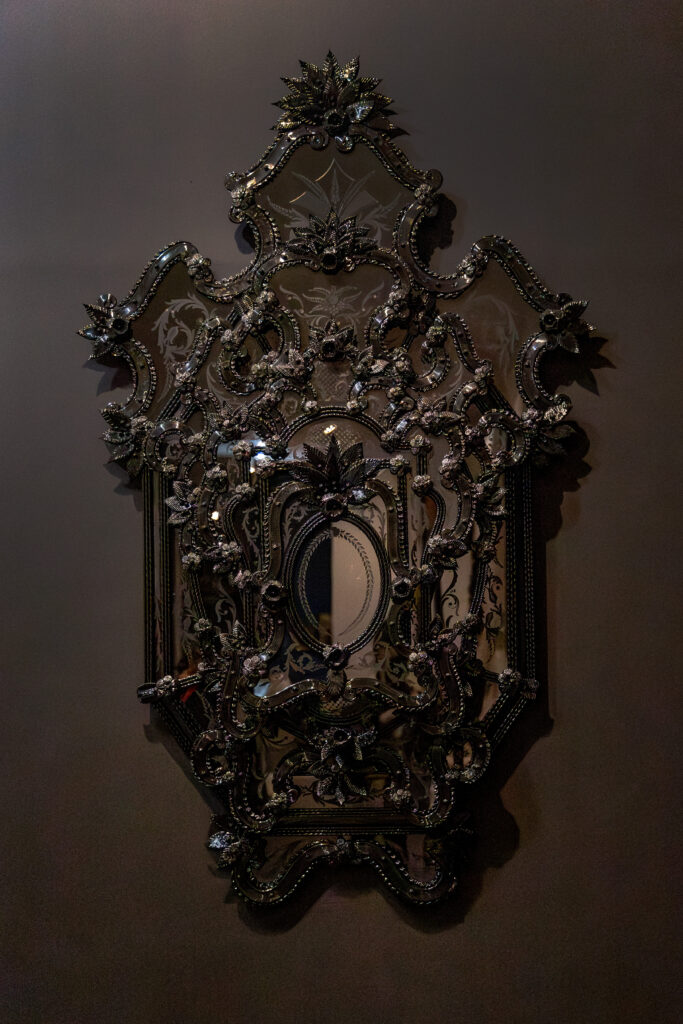
The work I saw today at the Brooklyn Museum, Iago’s Mirror, was made in 2009 from Murano glass. It is currently installed in the American Art galleries on the fifth floor as part of Toward Joy: New Frameworks for American Art, the museum’s ongoing reinstallation of American art.
The placement matters.
mirror, mirror on the wall
Wilson’s mirror sits in a corner among works in different mediums that all take black as subject, surface, atmosphere, or problem. They hang — or stand on pedestals — against a black wall, in an installation that turns color into conversation rather than backdrop.
Stephanie Sparling Williams, Andrew W. Mellon Curator of American Art at the Brooklyn Museum and the lead organizer of Toward Joy, described the grouping as a meditation on what it means to see the color black. Not simply to look at black, or through black, or past black, but to understand it as material, history, mood, resistance, opacity, elegance, and revelation.
That last word is crucial.
In the same grouping, a painting of a woman in black has been rehung so that the brushstrokes in the dark garment become newly visible. The black is no longer a zone of disappearance. It becomes active. The eye slows down. The surface starts speaking.
black as a revelation
The frame around that work was custom made for this new configuration, and the museum asked the framer to paint it “the deepest black possible” so that viewers could really see the painting.
It is an exquisite curatorial paradox: the deepest black does not conceal the work.
It clarifies it.
Wilson’s mirror belongs perfectly in that conversation.
Mirrors promise reflection, but they are never innocent. They flatter, distort, reverse, seduce, conceal. Wilson makes the mirror black — not silvered, not transparent, not obedient to the usual decorative contract.
The Brooklyn Museum notes that Iago’s Mirror draws on traditional eighteenth-century mirror designs and Murano glassmaking, but Wilson’s innovation was to paint the ornate glass layers black rather than back them with silvering. The museum’s interpretive material also connects the work to Shakespeare’s Iago, the antagonist who destroys Othello from the inside out.
When I asked Wilson what he thought — or perhaps hoped — people would see when they looked into Iago’s Mirror, he began with Iago himself. The work, he said, with its layers and layers of black glass and embellishment, is a manifestation of Iago’s sense of himself as the center of everything: his cruelty, his rage toward Othello, his furious insistence on his own grievance.
And then Wilson turned the mirror outward.
Everyone, he said, will see themselves in this mirror.
And they may see some things about themselves they had not noticed before.
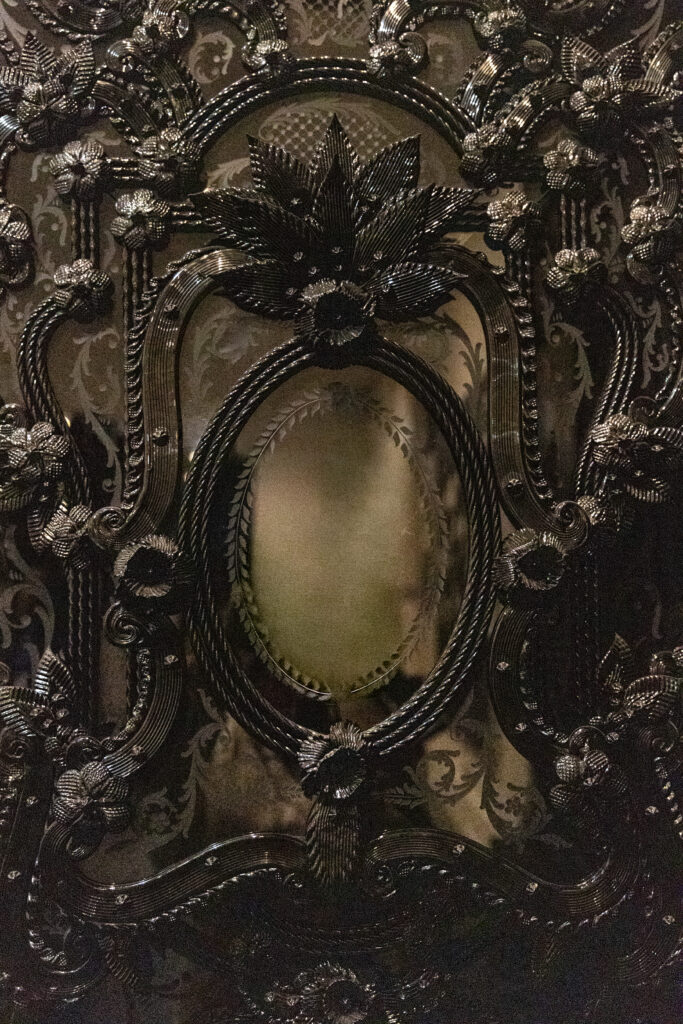
It is difficult to think of a more Wilsonian object: a luxury material turned into a historical trapdoor.
In this Brooklyn Museum installation, the mirror becomes part of a larger argument about blackness as color, symbol, surface, depth, rage, ornament, projection, and self-recognition.
There is no easy moral exit.
That, too, is the point.
where the real power lives in the art world
And then there is the story of how the mirror came back into view.
Saundra Williams-Cornwell, a longtime Brooklyn Museum trustee and Secretary of the Board of Trustees, was there today. She told Wilson that she had noticed Iago’s Mirror while touring the museum’s storage facilities. The work caught her eye. Later, when the conversation turned to what should appear in the reimagined American galleries, she remembered it.
representation matters
This is a moment to pause and notice.
A Black trustee sees a black mirror by a Black artist in storage. She remembers it. A Black woman curator, Stephanie Sparling Williams, builds a gallery conversation around what it means to see the color black. The work emerges from the museum’s holdings into public view, not as an isolated object, but as part of a larger visual argument about blackness, beauty, opacity, and revelation.
This is where real power lies in the art world. For a wider lens on how Black artists and cultural leaders are reshaping the systems around visibility and value, our essay The Black Avant-Garde traces the same force across contemporary culture.
Not only in auction prices, gala seating, blue-chip representation, or the clean violence of a wall label. Power lives in memory. In access, and in who walks through storage. Power lies in who knows enough to notice. In who has the authority to say: this belongs here. Look again.
Museums often describe reinstallation as a matter of scholarship, conservation, and design. It is all of those things. But it is also a matter of human attention — whose eye catches, whose memory holds, whose voice carries, whose judgment is trusted when the canon is being rearranged.
presence matters
That is why the identities of Williams-Cornwell and Williams matter here.
Not as symbolism.
As structure.
A Black trustee and a Black curator made a different kind of seeing possible.
Wilson’s mirror asks each viewer what they see when they look into darkness. The Brooklyn Museum installation asks something equally important: who had to see the work first so the rest of us could see it at all?
fred wilson’s current exhibitions in 2026
Wilson’s work is not confined to the canonical past. As of April 2026, Fred Wilson: The Flag Project is on view at the Rose Art Museum at Brandeis University through May 31, 2026. The exhibition presents a selection of Wilson’s Flag paintings in a mural-like procession in the museum’s Lois Foster Wing stairwell.
The Rose describes the project as a meditation on nationhood, ruptured histories, and Black diasporic dispersal. The presentation begins with Hidden Flag from 2012, whose red, black, and green bands evoke the Black liberation flag, followed by national flags from African and African diasporic countries rendered entirely in black paint on raw cotton canvas.
The materials do not whisper.
Cotton carries history. Black acrylic paint carries the present. The flags carry nations, routes, erasures, inheritances, and the possibility of liberation that has not yet completed itself.
So yes: Wilson is very much in the present tense.
why fred wilson matters now
There is a reason Wilson’s work feels newly urgent in 2026, even when it is rooted in questions he has been asking for decades.
Museums are again in a period of reckoning: about provenance, restitution, labor, representation, donor power, access, canon formation, and the language of display. Much of this conversation can become institutional fog — panel language, wall text, strategic planning, the usual velvet rope of abstraction.
Wilson cuts through that.
He does not simply say that institutions have histories, he shows how those histories are arranged in space.
The artist understands that display is never passive. The height of a pedestal is an argument. A vitrine is an argument. A label is an argument. A missing object is an argument. A chandelier, when made black, becomes an argument that happens to glitter.
Influence sometimes shows itself in the ability to change how a room thinks.
Wilson has done that for museums.
And once you see it, you cannot unsee it.
For another contemporary artist who uses beauty, surface, and art-historical memory to remake the terms of looking, see our essay Mickalene Thomas: All About Love at the Grand Palais.
faqs: fred wilson and the black mirror
who is Fred Wilson?
Fred Wilson is a Bronx-born, Manhattan-based conceptual artist known for installations, sculpture, glass works, and museum interventions that examine race, history, power, and the conventions of display. His work often reframes existing objects and cultural symbols to reveal narratives that museums and institutions have ignored, suppressed, or made difficult to see.
what is Fred Wilson best known for?
Fred Wilson is best known for Mining the Museum, his landmark 1992–93 installation at the Maryland Historical Society, and for works such as Guarded View, Speak of Me as I Am, Afro Kismet, and his Murano glass chandeliers and mirrors. His practice is central to institutional critique: art that examines how museums, collections, and cultural systems shape what the public sees and believes.
why is Fred Wilson’s Mining the Museum important?
Mining the Museum is important because it changed how many people understand museums. Wilson used objects from the Maryland Historical Society’s own collection to reveal how histories of slavery, racism, Native American presence, and Black life had been minimized or separated from the decorative and civic objects around them. By placing elegant silver near slave shackles and antique furniture near instruments of violence, he showed that museum display is never neutral.
what does Fred Wilson’s Iago’s Mirror mean?
Iago’s Mirror is a 2009 Murano-glass work by Fred Wilson that uses layers of black glass, ornament, and reflection to explore race, self-image, deception, and the violence of being seen through another person’s projection. The title refers to Iago in Shakespeare’s Othello, whose cruelty and rage toward Othello distort everything around him. Wilson described the work as connected to Iago’s sense of himself as the center of everything — and said that everyone who looks into the mirror will see themselves, including things they may not have noticed before.
where can you see Fred Wilson’s Iago’s Mirror?
You can see Iago’s Mirror in the Brooklyn Museum’s American Art galleries, where it is installed as part of Toward Joy: New Frameworks for American Art. The work appears in a black-walled grouping of paintings, sculptures, and objects that consider what it means to see the color black — as surface, material, symbol, opacity, elegance, and revelation.
what is Fred Wilson’s connection to Murano glass?
Fred Wilson uses Murano glass to examine Venice, Black diasporic history, ornament, luxury, and racialized looking. His 2003 Venice Biennale exhibition, Speak of Me as I Am, included black Murano glass chandeliers that reframed Venetian craft through the histories of Africans in Renaissance Venice and through Shakespeare’s Othello. In works like Iago’s Mirror, Wilson turns a material associated with beauty and refinement into a medium for history, discomfort, and self-recognition.
does Fred Wilson have a current exhibition in 2026?
Yes. As of April 2026, Fred Wilson: The Flag Project is on view at the Rose Art Museum at Brandeis University through May 31, 2026. The exhibition presents Wilson’s Flag paintings as a meditation on nationhood, Black diasporic dispersal, colonial histories, erasure, and unfinished liberation.
sources + further reading
- Brooklyn Museum — Iago’s Mirror
- Brooklyn Museum — Toward Joy
- Brooklyn Museum — Board of Trustees
- Brooklyn Museum — Fund for African American Art
- Whitney Museum — Guarded View
- MIT List Visual Arts Center — Speak of Me as I Am
- Rose Art Museum — The Flag Project