

We Walked on Concrete to See a Masterpiece
The Art Lens is Dandelion Chandelier’s ongoing series on art and visual culture, exploring how artists, exhibitions, and artworks shape perception, memory, and meaning beyond trend.
Richmond Barthé’s Exodus and Dance is a monumental 8-by-80-foot cast-stone frieze at Kingsborough Houses, a NYCHA public housing development in Brooklyn. Completed in 1939, installed in 1941, and restored in 2025, the work is one of New York’s most significant examples of Black modernist public art — and a reminder that masterpieces do not always live where the museum map tells us to look.
At a glance: Richmond Barthé • Exodus and Dance • Kingsborough Houses • NYCHA public art • Black modernism • WPA-era sculpture • Brooklyn cultural inheritance
richmond barthé’s exodus and dance at kingsborough houses
On a cold Saturday afternoon in April, in the middle of an unrelenting rainstorm, we made a pilgrimage to see a masterpiece.
We walked on concrete, not cobblestone. We passed modest, unadorned red-brick apartment buildings, their surfaces darkened by rain. There was no grand staircase, no hushed lobby, no elegant café promising proximity to culture. No visible whimsy, charm, or humor. Nothing in the approach offered the usual signals that one was nearing a work of consequence.

And then we turned a corner.
There it was: Richmond Barthé’s Exodus and Dance, eighty feet of cast stone and human motion, unfolding across a wall at Kingsborough Houses in Brooklyn. Figures moved through procession, pressure, ritual, music, and release. The rain made the surface feel newly awake. What had seemed ordinary suddenly became charged.
This is one of the quiet tricks of New York: the city’s cultural inheritance is not always waiting where the brochures say it will be.
Museums teach us to recognize importance through architecture. The marble stair. Wall label. Tuned light. The guard standing just close enough to remind us that looking is permitted, but touching is not. The bookstore. And the café. The small choreography of arrival that tells the visitor: you are now in the presence of art.
Exodus and Dance offers none of that.
It stands at a NYCHA housing development, in public, in weather, in daily life. Residents have long known it as “The Wall,” a name so plain it becomes almost majestic. Not a monument behind velvet rope. Not a trophy on institutional loan. A wall. A presence. A work of Black modernism living among people as part of the architecture of home.
That is the story.
All photographs by Pamela Thomas-Graham for Dandelion Chandelier.
the masterpiece outside the museum
Richmond Barthé was one of the great American sculptors of the twentieth century, and one of the most important Black artists to emerge from the Harlem Renaissance. Born in Mississippi in 1901, he became known for sculpture that translated the human body into rhythm: dancers, saints, boxers, actors, spiritual figures, and mythic presences whose gestures carried emotional force.
He understood movement not as decoration, but as revelation.
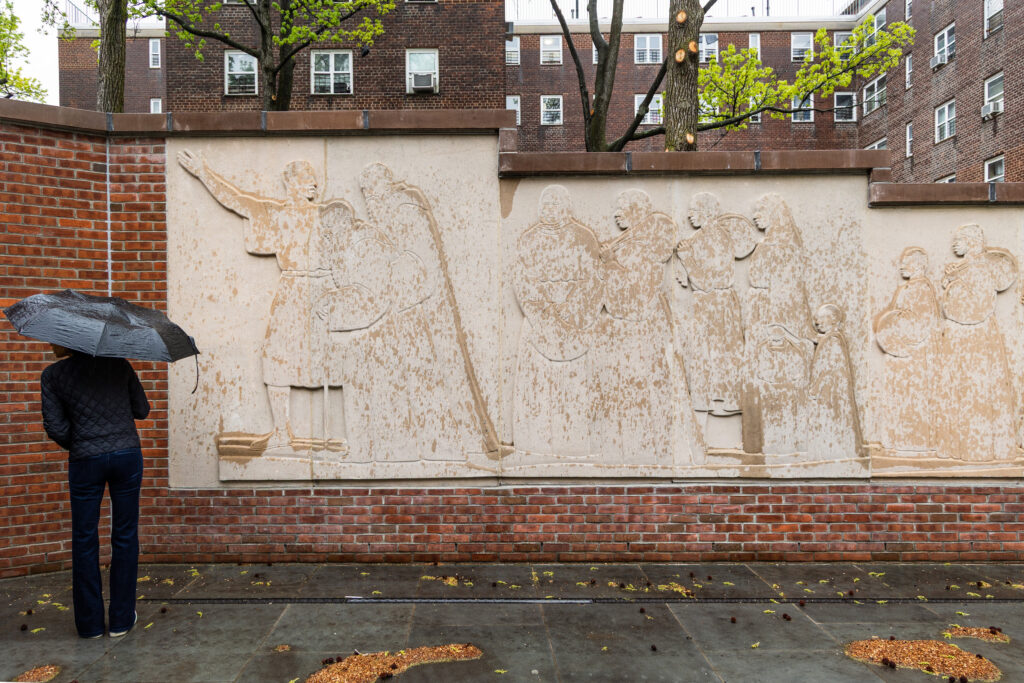
In Exodus and Dance, completed in 1939, that gift becomes monumental. The frieze is roughly eight feet high and eighty feet long, and its subject is not a single heroic figure but a collective body in motion. Some figures seem to process. Others seem to dance. Some appear suspended between burden and release. The title itself contains the tension: exodus and dance. Flight and celebration. Departure and embodiment. The hard road and the ecstatic body that survives it.
Barthé’s genius is in the way he makes motion carry thought. The same idea of movement as cultural memory animates Black Innovators Shaping Contemporary Dance, where the body becomes archive, argument, and instrument at once.
The figures in Exodus and Dance are not simply arranged; they are propelled. Knees bend, torsos tilt, arms lift, bodies press forward and open outward. The work seems to understand that Black history is not a static subject, but a moving one — migration, worship, labor, performance, departure, survival, and joy all traveling through the body at once.
The work was originally created for Harlem River Houses, one of the nation’s first federally funded public housing developments built for Black residents. It was later installed at Kingsborough Houses in 1941. Over time, the work also carried the title Green Pastures: The Walls of Jericho, before being restored to public attention under its original name, Exodus and Dance.
That origin matters.
This was not art as afterthought. It belonged to an era when public housing, at its most ambitious, imagined itself as civic architecture. Not merely shelter. Not warehousing. A built environment with social purpose, artistic presence, and collective dignity.
That idea now feels almost radical.
the wall was never waiting to be discovered
It is tempting to describe a work like this as “hidden.” The word has a seductive usefulness. Hidden masterpiece. Hidden gem. And hidden history. It flatters the discoverer.
But the more honest sentence is sharper: Exodus and Dance was not hidden from everyone. It was hidden from the people who decide where cultural importance is supposed to live.
Residents saw it. Children passed it. Elders knew it. The wall weathered seasons, neglect, admiration, and use. It did not need a museum to make it real.
It needed preservation.
For more than eighty years, Exodus and Dance stood at Kingsborough Houses. NYCHA has noted that residents knew the work as “The Wall,” and that its restoration revived a powerful symbol of shared history and cultural pride. That phrase — shared history — is doing a great deal of work. Shared by whom? The residents, certainly. The neighborhood, yes. But also the city, if the city is willing to claim the full geography of its own inheritance.
The masterpiece had already been there.
The failure of attention belonged elsewhere.
That question — who gets seen, who gets preserved, and who is allowed to shape the cultural record — also runs through Black Leadership in the Art World, our look at the curators, trustees, gallerists, advisors, and collectors changing the architecture of authority.
For another encounter with public art hiding in plain sight, In Brooklyn’s War Monuments, Black Men Are Cast in the Background considers what happens when Black figures appear in civic sculpture, but are placed visually and symbolically in service to someone else’s monument.
public housing as cultural inheritance
This is where the piece becomes larger than Barthé, larger than one wall, larger even than the restoration itself.
Exodus and Dance asks a question that every serious cultural publication should be willing to answer honestly: who gets daily proximity to beauty?
Not special-occasion beauty. Not ticketed beauty. And not beauty as access, reward, or credential. Daily beauty. Civic beauty. The beauty one encounters while taking out the trash, walking home in rain, waiting for a friend, crossing an open space one has crossed a thousand times before.
There is a kind of public luxury in that.
Not luxury as price. Luxury as seriousness. Luxury as the decision to place art where ordinary life happens. And luxury as the belief that common space deserves works of consequence.
A different but related form of place-based inheritance appears in Finding Home on Martha’s Vineyard, where belonging is held not in institutions alone, but in landscape, ritual, memory, and return.
That is a very different proposition from the privatized luxury of our own moment, in which beauty is too often fenced, coded, reserved, or branded. Barthé’s wall belongs to another civic imagination: one in which Black bodies in motion, rendered by a Black sculptor at monumental scale, could become part of the daily architecture of public life.
The fact that this happened at public housing is not incidental.
It’s the whole point.
what restoration really restores
The recent restoration of Exodus and Dance was not merely a technical achievement, though it was certainly that. EverGreene Architectural Arts has described the project as a large-scale stone conservation effort in which the frieze was removed from its location, transported to the firm’s Brooklyn conservation studio, restored, and reinstalled.
The project was a collaboration involving NYCHA, the Public Housing Community Fund, the Mellon Foundation, and the New York City Council, among others. The Preservation League of NYS noted that conservators removed, cleaned, repaired, and reinstalled the frieze on a new support wall, with upgrades to the surrounding plaza including new pavement and lighting.
But restoration, at its best, is never only about material.
It restores a relationship between a work and its public. And it restores legibility. It restores the possibility of attention. And reminds the city that the object it allowed to fade was carrying memory all along.
That is why seeing the work in the rain felt so moving. Not because rain makes everything romantic. It does not. Rain can make a walk feel longer, colder, less forgiving. The concrete was concrete. The brick was brick. The day did not perform prettiness.
And yet the wall did.
Or perhaps more accurately: the wall did not perform. It stood there, restored and present, asking to be seen without softening the conditions around it.
That is a harder, better kind of beauty.
black modernism, without permission
Part of Barthé’s force is that his figures do not ask permission to occupy space. They are elegant, but not timid. Rhythmic, but not decorative. Spiritual, but not sentimental. They carry histories of migration, faith, theater, ritual, and Black performance without collapsing into explanation.
In lesser hands, “exodus” and “dance” might become symbols. Barthé makes them physical.

The bodies bend, step, lean, lift, turn. They do what bodies do when history presses upon them: they bear weight, and they move anyway.
That is why the work feels so contemporary. Not because it needs to be updated, but because the questions it raises are still active. Who is allowed monumentality? Which bodies become public art? Which neighborhoods are treated as deserving of preservation? And which histories are considered central, and which are asked to wait outside until someone with authority notices?
The answer Barthé gives is sculptural, not rhetorical.
He makes Black motion monumental.
For a contemporary Brooklyn counterpoint, Derrick Adams and the Hard Work of Black Joy explores how Black joy, leisure, discipline, and self-possession continue to become serious visual language in the hands of an artist working now.
the city had to learn to look again
There is a particular kind of cultural blindness that afflicts cities. We become fluent in the obvious. We know which museum shows to see, which galleries matter, which new building has the right architect, which restaurant has the right lighting, which neighborhood has become safe to call “interesting” in print.
But cultural intelligence requires a more demanding habit.
It requires going where the map of prestige is incomplete.
It’s the inverse of the art pilgrimage we describe in The Best Destination Art Museums in the World: sometimes the journey leads to architecture designed to consecrate art, and sometimes it leads to a wall in Brooklyn consecrated by endurance.
That is what made the visit feel like a pilgrimage. Not because the route was picturesque. It was not. Because the destination required a different form of attention. We were not being ushered toward art by the usual signs. We had to trust that the masterpiece was there.
Then the wall appeared, and the whole scene changed.
A plain walk became a threshold. A housing development became an archive. A restored public artwork became a rebuke to every lazy assumption about where beauty is supposed to appear.
The city did not need to create significance there. Significance was already there.
The city needed to look again.
That same act of looking again sits at the center of our essay on Fred Wilson’s Iago’s Mirror at the Brooklyn Museum, where the museum itself becomes both subject and witness.
the truer version is stewardship
The visit also rearranged the day.
To stand in front of Barthé’s wall after thinking about Black artists, museums, trustees, studios, and public memory is to see a larger pattern come into focus. Cultural power does not live in one place. It moves between institutions, artists, collectors, residents, foundations, trustees, teachers, conservators, and the people who simply keep passing the work and knowing what it is.
The glamorous version of art history loves discovery.
The truer version is stewardship.
Exodus and Dance is rare. It is beautifully made; it carries immense cultural meaning. The work has survived weather, neglect, and time. It belongs to a lineage of Black artistic brilliance, New York civic ambition, WPA-era public art, and the unfinished American argument about who deserves beauty in everyday life.
That is what made the encounter feel so bracing.
Not that a masterpiece had been “found.”
That the masterpiece had been there all along, waiting for the city’s attention to catch up with its own inheritance.
the walk back was not the walk in
When we arrived, the rain had made everything feel stripped down. No golden hour. No flattering light. And no romance of the city conspiring on behalf of the photograph.
Just wet pavement, red brick, cold air, and a wall.

And then, suddenly, not just a wall.
This is the memory that stayed: how quickly the ordinary can become charged when art is allowed to remain in public life. How little scenery a masterpiece actually needs. How much of our idea of culture depends on the architecture around it. And how wrong those assumptions can be.
When we left, the rain had not stopped. The buildings had not changed. The concrete was still concrete.
But the walk back was not the walk in.
That is what art does when it is allowed to remain in public life. It does not remove us from the world. It changes the terms on which we see it.
The masterpiece had not been waiting for us to discover it. It had been there all along.
We were the ones learning where to look.
faqs: richmond barthé’s exodus and dance at kingsborough houses
Where is Richmond Barthé’s Exodus and Dance located?
Richmond Barthé’s Exodus and Dance is located at Kingsborough Houses, a NYCHA public housing development in Brooklyn. The work has stood there since 1941 and has long been known by residents as “The Wall.”
What is Exodus and Dance by Richmond Barthé?
Exodus and Dance is a monumental cast-stone frieze by Richmond Barthé, completed in 1939. It is approximately eight feet high and eighty feet long, and it depicts Black figures in motion, moving through scenes of procession, dance, faith, migration, and release.
Why is Richmond Barthé important?
Richmond Barthé was a major twentieth-century American sculptor associated with the Harlem Renaissance. His work is known for its expressive treatment of the body, especially figures shaped by dance, spirituality, performance, and Black cultural history.
Was Exodus and Dance originally made for Kingsborough Houses?
No. Barthé created Exodus and Dance for Harlem River Houses, and the work was later installed at Kingsborough Houses in 1941. In later years it was also known as Green Pastures: The Walls of Jericho, though it has since been restored to public attention under its original title.
Who restored Exodus and Dance at Kingsborough Houses?
The restoration involved NYCHA, the Public Housing Community Fund, the Mellon Foundation, the New York City Council, and EverGreene Architectural Arts. The conservation project included removing the frieze, restoring it in a conservation studio, building a new support wall, replacing pavement, and upgrading lighting.
Why does Exodus and Dance matter now?
The work matters because it challenges assumptions about where major art lives and who gets daily access to beauty. As a monumental work of Black modernist public art installed in public housing, it connects art history, civic space, preservation, and cultural inheritance.
Can the public visit Exodus and Dance?
The work is installed outdoors at Kingsborough Houses in Brooklyn. Because it is located within a residential NYCHA development, visitors should approach respectfully, treating the site not as a conventional museum destination but as a living community space.
Sources + further reading
- NYCHA Journal — restoration overview
- NY LGBT Historic Sites Project — Barthé history
- EverGreene Architectural Arts — conservation work
- Public Housing Community Fund — project support
- AIA New York — project recognition