

Portraits of Influence is Dandelion Chandelier’s ongoing series of profiles and interviews with cultural leaders shaping art, business, fashion, and modern luxury.
Derrick Adams’ work is often described through Black joy, leisure, color, portraiture, and contemporary Black life. But after visiting his Crown Heights studio, the clearer word may be discipline: the discipline of looking closely, of remembering people as they choose to carry themselves, and of making pleasure serious without draining it of delight.
This is a studio visit with Derrick Adams, the Baltimore-born, Brooklyn-based multidisciplinary artist whose work spans painting, drawing, collage, installation, sculpture, performance, teaching, and community-building. His first mid-career survey, Derrick Adams: View Master, is on view at the Institute of Contemporary Art/Boston from April 16 through September 7, 2026, bringing together more than twenty years of work centered on contemporary Black life, leisure, freedom, and the pursuit of happiness.
At a glance: Derrick Adams • Crown Heights studio visit • Black joy • portraiture • pop culture • self-possession • ICA Boston • Gagosian
All photographs are by Pamela Thomas-Graham for Dandelion Chandelier.
the hard work of black joy
I have three works by Adams in my personal collection. But this was my first time visiting his studio.
That difference matters.
Collecting, at its best, is not acquisition. It is a long act of looking. And there is something quietly clarifying about stepping into the room where the images one has lived with first became possible — where the paint, brushes, fragments, shelves, studio tables, and accumulated evidence of practice reveal that joy is not a mood Adams casually applies to the surface.
That joy is made by hand. Worked for. Held to a standard.
This lineage of Black joy as discipline, structure, and public presence also runs through Richmond Barthé’s restored Exodus and Dance at Kingsborough Houses, where bodies in motion turn survival, ritual, and release into monumental public art.
inside the crown heights studio
The studio is in Crown Heights, Brooklyn, and it feels less like a stage than a working intelligence.
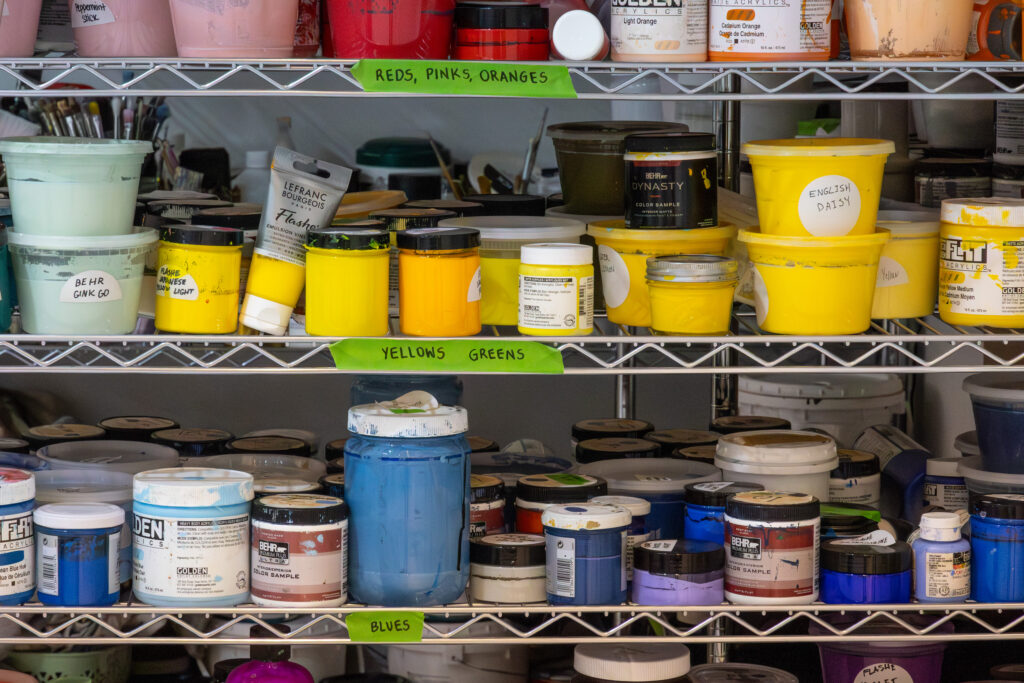
There are pots of paint, brushes, materials, visual fragments, objects waiting to be absorbed into use. The atmosphere is not precious. It is alert. Color sits everywhere, but not as decoration. Color here behaves like syntax: selected, tested, repeated, revised.

Adams himself moves easily through this world. He can draw. And paint. He can build installations and stage live performances. And he can speak about television, teaching, neighborhood life, Jacob Lawrence, Baltimore, Issa Rae, the politics of being called “commercial,” and the private choreography of a person’s slouch without making any of those subjects feel separate from the others.
That is the first thing to understand about him: the range is not restlessness.
It is method.
His practice is polymathic, but not scattered. The drawings, paintings, performances, teaching, installations, public projects, and Baltimore community work all seem to orbit the same question: how do Black people occupy space when they are not being reduced, explained, defended, or flattened?
How do they move? How do they rest? And how do they look back?
This studio visit belongs in conversation with Open House: An Art Walk Through Black Contemporary Art, where Black contemporary art is treated not as a market category, but as a living architecture of memory, pleasure, power, and presence.

what makes a person worth remembering
During the visit, I asked Adams a question.
Given that so much of his work centers on the human face, how does he decide what makes for a great portrait? He had just been talking about finding inspiration while walking to the corner bodega or around the neighborhood. So I asked what kind of person tends to catch his eye.
His answer was not about symmetry, beauty, expression, celebrity, or biography.
It was about bearing.
He said he does not take photographs of actual people and then reproduce them. He draws instead from memory — from the people who stay with him after he has seen them moving through ordinary life.
“I like people who are sure of themselves,” he said.
Then he explained what that meant. He did not mind a man slouching, he said, if the slouch was his — if that was how the man deliberately chose to carry himself. He liked people in motion. For instance, he remembered seeing a young mother dropping two children off at school while wearing a blue wig and flip-flops. That, he said, fascinated him: she had chosen the wig, styled it, and entered the morning that way.
Not for an event. Not for an audience.
Because that was who she was.
Those are the people who stay with him. Not the ones looking down. The ones who look straight at him.
It was the most revealing answer of the visit.
That question of who gets remembered — and who gets to meet the gaze directly — also echoes Love, Seen: How Painters Teach Us to Look, our essay on looking as one of art’s most charged emotional acts.
For Adams, the great portrait begins before the canvas. It begins with a person who has already made a decision about how to enter the world.
the portrait as self-possession
A slouch can be a thesis if it belongs to the person wearing it.
That may be the hidden key to Adams’ portraiture. His faces are not merely faces. They are acts of self-authorship. They hold posture, rhythm, style, humor, defensiveness, ease, adornment, interiority, and refusal.
The people in Adams’ work often seem composed not because they are still, but because they are internally organized. They know something about themselves. They have made choices: about color, hair, pattern, clothes, leisure, humor, domesticity, where to sit, how to stand, when to look away, when to look directly back.

That is why the recurring emphasis on Black joy in his work needs to be understood with some precision. This is not joy as softness. It is not joy as innocence. This is not joy as an escape hatch from politics.
This is joy as sovereignty.
For a broader visual history of leisure, visibility, and who is permitted to exhale in public, The Season of Being Seen: Famous Paintings About Summer makes a useful companion to Adams’ insistence on rest, pleasure, and self-possession.
The figures Adams remembers are not asking to be seen. They are already visible to themselves. That is the harder thing.
A blue wig at school drop-off. Flip-flops in motion. A chosen slouch. A face that refuses to lower itself.
In that sense, his portraits are not likenesses so much as recognitions.
the favorite student
Adams teaches at Brooklyn College, where he is listed as an associate professor in the School of Visual, Media and Performing Arts. During our conversation, he told me he has a favorite student every semester.
This sounded dangerous for exactly half a second.
Then he explained.
His favorite student is the person who works the hardest.
Not necessarily the most naturally gifted. Nor the most polished. Not the one who arrives with the most confidence or the most obvious fluency. The one who works. The one whose effort sets the level of the room.
That person, he said, establishes what an A looks like. Everyone else has to match that energy and commitment, or settle for a lower grade.
It was an unexpectedly perfect key to the work.
Adams’ paintings, installations, and performances may glow with pleasure, humor, color, and cultural ease. But nothing about them is casual. Underneath the delight is an exacting respect for effort. Style is not ease. Color is not decoration. Popularity is not softness. A room can be joyful and still have standards.
Perhaps that is why the work does not collapse into charm.
It has a spine.
why commercial is not a dirty word
Adams also spoke about the word “commercial” — how it can be used against an artist.
It is a familiar form of art-world discipline. When an artist speaks fluently in beauty, entertainment, television, fashion, humor, design, music, recognizability, or pleasure, “commercial” can become a narrowing word. A way of implying that the work is too legible, too popular, too seductive, too close to the world outside the white cube.
But Adams is genuinely interested in how Black people are portrayed in entertainment and pop culture.
That interest is not a concession. It is a serious field of study.
To dismiss popular culture as merely commercial is to misunderstand where images of contemporary life are made, circulated, loved, repeated, distorted, and transformed. Television, music, fashion, comedy, beauty culture, nightlife, interiors, advertising, social media, and neighborhood style are not outside the visual culture of Black life. They are often where that culture is most alive.
The point is not that Adams brings pop culture into fine art to make it more accessible.
The point is that he understands popular culture as one of the places where Black self-presentation is constantly being negotiated.
Who gets to be funny?
Who gets to be glamorous?
Who gets to be ordinary?
Who gets to be at rest?
Who gets to be seen in color?
when issa rae understood the room
One of the most telling anecdotes Adams shared was about Issa Rae.
She asked to shoot an episode of Insecure at one of his art installations. Adams said it was a great collaboration because each of them understood the other.
That line stayed with me.
The collaboration worked not because a television show borrowed an art installation as a beautiful backdrop, but because the two projects were already speaking related languages. Rae’s work on Insecure helped reshape how contemporary Black adulthood, friendship, ambition, awkwardness, humor, romance, and interior life could appear on screen. Adams’ work has long been interested in related territory: leisure, pose, domesticity, style, performance, aspiration, self-fashioning, and the everyday drama of being seen.
The installation did not become set dressing.
It became part of a shared grammar.
The museum wall and the television frame are not identical.
But they both teach us how to see.
a polymath’s discipline
Adams’ current institutional moment is substantial. Gagosian’s archive lists recent exhibitions including The Strip in Seoul in 2024, Situation Comedy in London in 2025, and The Omnipotence of Dreams in Gstaad from December 2025 to January 2026. ICA Boston’s View Master now frames more than twenty years of work as a sweeping mid-career survey.
But the studio visit made the breadth feel less like résumé and more like infrastructure.
Adams is a painter, but not only a painter. He draws, builds, performs, teaches, stages, collaborates, and creates environments. At SCAD, in connection with a commemoration of Jacob Lawrence, he participated in a multidisciplinary performance that extended his practice into live staging and collective interpretation. The point is not that Adams can do many things. The point is that he understands form as a choice.
Some ideas require a face.
Others require a room.
Some require movement.
Some require students.
And some require Baltimore.
from brooklyn to baltimore
Adams was born in Baltimore in 1970 and now lives and works in New York. Gagosian notes that he received his BFA from Pratt Institute in 1996 and his MFA from Columbia University in 2003. But Baltimore is not just biography in his story. It remains a site of return and responsibility.
He is the founder of The Last Resort Artist Retreat, a Baltimore-based space created to support Black creatives through leisure, rest, emotional wellness, community, and artistic freedom. The organization describes its mission as nurturing a space where Black creatives can innovate and expand upon the Black experience.
This, too, belongs inside the work.
Not as a charitable sidebar. Not as a civic footnote. As an extension of the visual argument.
Adams’ paintings often insist that Black people deserve rest, pleasure, interiority, leisure, experimentation, beauty, and self-possession. The Last Resort makes that insistence spatial. It turns an aesthetic principle into a place.
A retreat, in this context, is not withdrawal.
It is repair.
Permission.
A room in which the standard is not exhaustion.
what collectors see first
As I mentioned, I own three works by Derrick Adams. Living with them is different from seeing them reproduced, and different again from visiting the studio where the larger practice comes into focus.
Collectors often speak in the language of acquisition, rarity, and timing. But the more interesting question is what one recognized before the institutional crescendo became impossible to miss.
In Adams’ work, what I saw first was presence.
Not spectacle. Nor trend. Not a simplified celebration. Presence.
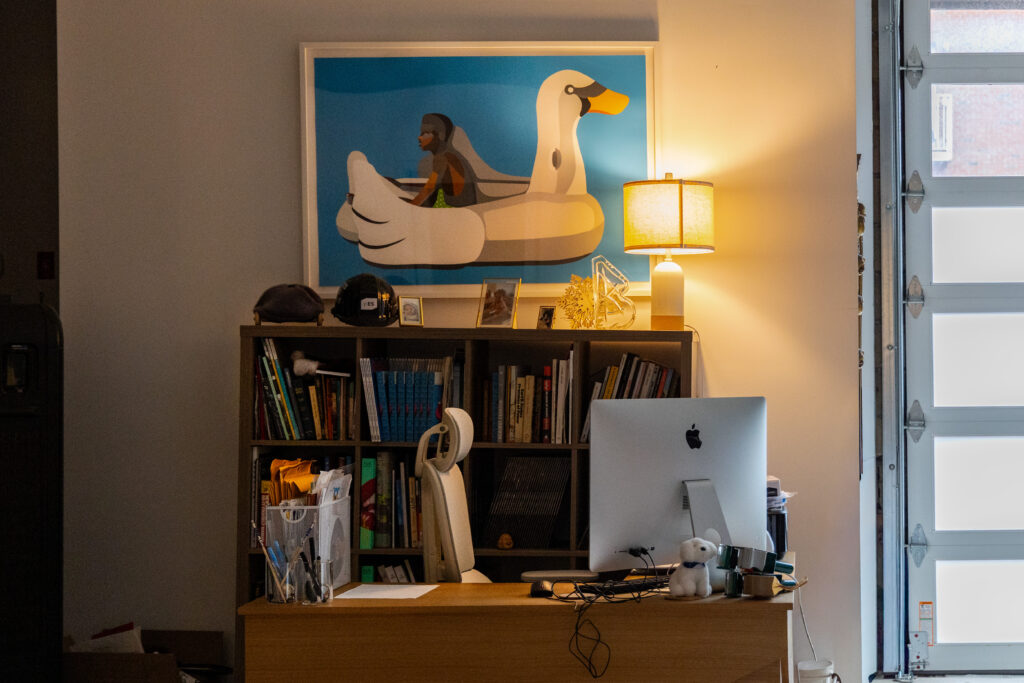
The people in his images have their own weather. Their own geometry. Their own private logic of presentation. A face may be built from planes of color, but it does not feel fragmented. It feels assembled — actively, knowingly, almost architecturally.
That is why his work rewards living with it. The first encounter may be with color, pattern, wit, and formal confidence. The longer encounter is with the standard underneath.
The figures do not ask for permission to be complex.
They arrive that way.
the hard work of black joy
The phrase Black joy is used often now, and for good reason. It names something necessary. It refuses the cruel expectation that Black art must endlessly rehearse suffering in order to be treated as serious.
But the phrase can also be flattened when it is treated as mood rather than labor.
Derrick Adams’ work resists that flattening.
The joy in his world is worked for. It is remembered from the street and carried back to the studio. Taught in classrooms where the hardest-working student sets the bar. Defended against lazy accusations of commerciality. It is found in television, beauty culture, domestic interiors, performance, leisure and neighborhood style.
Derrick Adams’ work insists on Black presence as centered, expansive, and self-possessed — a striking counterpoint to the older public sculptures examined in In Brooklyn’s War Monuments, Black Men Are Cast in the Background, where Black male figures appear, but rarely as the subject of honor.
This joy is not fragile.
That may be why Adams’ work feels so generous without ever feeling lax. He gives the viewer pleasure, but not permission to underestimate it. He makes room for delight, but he does not lower the standard.
In Derrick Adams’ world, a portrait begins when a person decides not to look down.
faqs:
who is derrick adams?
Derrick Adams is a Baltimore-born, Brooklyn-based multidisciplinary artist whose work spans painting, drawing, collage, sculpture, installation, performance, video, and public projects. His practice is widely known for its exploration of contemporary Black life, Black joy, leisure, popular culture, portraiture, and self-representation.
what is derrick adams known for?
Derrick Adams is known for vivid, collage-inspired portraits and scenes of Black life, leisure, rest, style, entertainment, and everyday self-possession. His work often uses bold color, geometric forms, popular culture, and domestic or social settings to expand how Black people are represented in contemporary art.
where is derrick adams’ 2026 museum exhibition?
Derrick Adams: View Master is on view at the Institute of Contemporary Art/Boston from April 16 through September 7, 2026. ICA Boston describes the exhibition as Adams’ first mid-career survey and a presentation of more than twenty years of work.
what does black joy mean in derrick adams’ work?
In Derrick Adams’ work, Black joy is not simply happiness or celebration. It appears as rest, leisure, style, humor, self-possession, community, entertainment, beauty, and the right to be seen beyond trauma, respectability, or explanation.
why is portraiture important in derrick adams’ art?
Portraiture is central to Derrick Adams’ art because the face becomes a site of memory, posture, identity, and self-authorship. His figures often feel powerful not because they are idealized, but because they seem sure of themselves — composed, styled, and unwilling to look down.
how does derrick adams use pop culture?
Derrick Adams uses pop culture as serious visual material, drawing on television, entertainment, fashion, humor, beauty culture, and everyday style to examine how Black life is represented and circulated. His work challenges the idea that popular or “commercial” imagery is less intellectually important than traditional fine-art subjects.
what is the last resort artist retreat?
The Last Resort Artist Retreat is a Baltimore-based retreat founded by Derrick Adams to support Black creatives through rest, leisure, community, emotional wellness, and artistic freedom. Its mission extends many of the ideas in Adams’ work into a physical space for creative restoration and exchange.
sources + further reading
- ICA Boston — Derrick Adams exhibit details
- Gagosian — artist profile
- Brooklyn College — faculty profile
- The Last Resort — artist retreat
- ArtsATL — SCAD performance